Name of Subscriber:
Number of Registration:
CONFIDENTIAL PRIVATE placement MEMORANDUM
LOS ANGELES CITY PLAZA, LP
(a CALIFORNIA limited PARTNERSHIP)
Up to $12,000,000
Up to 15 Units of Class B Limited Partnership Interests
Dated: June 10, 2023
CONFIDENTIAL PRIVATE PLACEMENT MEMORANDUM
LOS ANGELES CITY PLAZA, LP
(a California limited partnership)
CLASS B LIMITED PARTNERSHIP INTERESTS
This Confidential Private Offering Memorandum (this “Memorandum”) is submitted on a confidential basis for use by a limited number of potential non-”U.S. Person” investors (hereinafter, “Investors”, “Investor Partners”, or “Subscribers”) solely in consideration of the acquisition of the above-captioned securities in a private placement. The acceptance of this Memorandum constitutes agreement on the part of the recipient hereof and its representatives to maintain the confidentiality of the information contained herein. This Memorandum may not be reproduced in whole or in part, and its use for any purpose other than an investment in the securities described herein is not authorized and is prohibited. All dollar amounts contained herein are in United States dollars. The date of this Offering is June 10, 2023.
Los Angeles City Plaza, LP, a California limited liability company (variously hereinafter, the “Offeror” or the “Company”), hereby offers (the “Offering”) Class B Limited Partnership Interests (“Units”) in Offeror. The Company was formed on June 18, 2012, pursuant to the California Uniform Limited Partnership Act of 2008, for the purposes of raising the Investment Amount (estimated to be $12 million) or such greater or lesser amount as determined by the General Partner. The proceeds of the Offering will be used to finance, in part, the development and operations of the Long Beach Homes Project which consists of a 4-story, approximately 90,200 square foot mixed-use development consisting of 4,800 square feet of retail space for lease, two restaurants totaling 5,256 square feet, at 36 residential condominium units for sale at 1598 Long Beach Boulevard, Long Beach, California 90813 (collectively referred to as the “Project”) all as described in further detail in this Memorandum, below. Final square foot and building setup may vary subject to market change and/or requirement by government.
Securities: Units
Unit Price: $800,000 per Unit
Minimum Investment: One (1) Unit
Administrative Fee1: $70,000
1 (per subscription, in addition to Minimum Investment)
California Investment Regional Center, LLC, a California limited liability company (“General Partner”), with its principal place of business located at 1598 Long Beach Blvd., Unit 101, Long Beach, CA 90813, is the General Partner (and also a Partner) and Regional Center of the Company.
The Offering shall continue until either (a) all of the unsold Units are sold, or until (b) the General Partner closes the Offering, which in its sole and exclusive discretion it may do prior to raising the entire amount of the Offering. There is no firm commitment by the Offeror to purchase or sell any Units, and there is no assurance that any of the Units will be sold. In connection with or following the Company’s acceptance of your Subscription Agreement, it will send each Investor wire instructions (or check delivery instructions) so each Investor can deliver to the Company those amounts required to participate in the Offering. The Offeror reserves the right to accept or reject any subscription for any reason. Any subscriptions not accepted will be returned without interest, less any bank fees and actual costs incurred. The total proceeds from the subscriptions to the Offering and the Administrative Fees will be deposited into two separate accounts. A copy of the Subscription and a copy of the EB-5 Services Agreement is attached as Exhibit D.
THE INTERESTS OFFERED HEREBY HAVE NOT BEEN REGISTERED UNDER THE SECURITIES ACT OF 1933, AS AMENDED (THE “SECURITIES ACT”), OR WITH THE COMMISSIONER OF CORPORATIONS OF ANY STATE, AND ARE BEING OFFERED AND SOLD ONLY TO A LIMITED NUMBER OF QUALIFIED INVESTORS IN RELIANCE ON AN EXEMPTION FROM REGISTRATION UNDER SECTION 4(A)(2) OF THE SECURITIES ACT, REGULATION D, AND/OR REGULATION S PROMULGATED THEREUNDER, AND APPLICABLE STATE SECURITIES (“BLUE SKY”) LAWS.
THESE SECURITIES HAVE NOT BEEN APPROVED OR DISAPPROVED BY THE SECURITIES AND EXCHANGE COMMISSION (THE “COMMISSION”), NOR HAS THE COMMISSION, OR ANY STATE SECURITIES COMMISSION OR OTHER REGULATORY AUTHORITY, PASSED UPON THE ACCURACY OR ADEQUACY OF THESE OFFERING MATERIALS. ANY REPRESENTATION TO THE CONTRARY IS A CRIMINAL OFFENSE.
IN MAKING AN INVESTMENT DECISION, INVESTORS MUST RELY ON THEIR OWN EXAMINATION OF THE OFFEROR AND THE TERMS OF THE OFFERING, INCLUDING THE MERITS AND RISKS INVOLVED. THESE SECURITIES HAVE NOT BEEN RECOMMENDED BY ANY FEDERAL OR STATE SECURITIES COMMISSION OR REGULATORY AUTHORITY. ANY REPRESENTATION TO THE CONTRARY IS A CRIMINAL OFFENSE.
THE SECURITIES OFFERED HEREBY SHALL NOT BE REGISTERED UNDER THE SECURITIES ACT OR UNDER ANY STATE BLUE SKY LAWS. IF A SECURITY IS SOLD SOLELY PURSUANT TO THE EXEMPTION PROVISIONS OF REGULATION S, THEN THE SECURITIES MAY BE SOLD ONLY TO A NON-U.S. PERSON. HEDGING TRANSACTIONS INVOLVING THESE SECURITIES MAY NOT BE CONDUCTED UNLESS IN COMPLIANCE WITH THE SECURITIES ACT.
CERTIFICATES, IF ANY, REPRESENTING THE INTERESTS SOLD HEREBY SHALL BEAR A LEGEND RECITING THAT TRANSFER OF SAID INTERESTS IS PROHIBITED EXCEPT IN ACCORDANCE WITH THE SECURITIES ACT AND REGULATION S, PURSUANT TO REGISTRATION UNDER THE SECURITIES ACT, OR PURSUANT TO AN AVAILABLE EXEMPTION FROM REGISTRATION, AND THAT HEDGING TRANSACTIONS INVOLVING THE UNITS MAY ONLY BE CONDUCTED IN COMPLIANCE WITH THE SECURITIES ACT.
THIS IS A PRIVATE OFFERING INVOLVING A HIGH DEGREE OF RISK. OFFERS MADE PURSUANT TO REGULATION D WILL BE MADE TO INVESTORS WHO ARE “ACCREDITED INVESTORS” AS DEFINED IN REGULATION D PROMULGATED UNDER THE SECURITIES ACT AND UP TO 35 NON-ACCREDITED INVESTORS. ALL INVESTORS WILL BE REQUIRED TO REPRESENT AND WARRANT THAT THEY ARE FAMILIAR WITH AND UNDERSTAND THE TERMS, RISKS, AND MERITS OF THIS OFFERING.
EACH INVESTOR MUST HAVE SUCH KNOWLEDGE AND EXPERIENCE IN FINANCIAL AND BUSINESS MATTERS THAT SUCH INVESTOR IS CAPABLE OF EVALUATING THE MERITS AND RISKS OF THIS INVESTMENT, EITHER ON HIS/HER OWN OR TOGETHER WITH HIS/HER ADVISORS AND REPRESENTATIVES, AND MUST BE ABLE TO BEAR THE ECONOMIC RISKS OF THIS INVESTMENT. NO OFFER IS BEING MADE HEREBY TO ANY PERSON WHO DOES NOT DEMONSTRATE BY THE INFORMATION SUCH PERSON PROVIDES TO THE OFFEROR THAT THE PERSON MEETS THE SUITABILITY STANDARDS FOR THIS OFFERING.
THE TRANSFERABILITY OF THE CLASS B LIMITED PARTNERSHIP INTERESTS DESCRIBED HEREIN IS HIGHLY RESTRICTED. IN THE EVENT AN INVESTOR SHOULD DESIRE TO DO SO, THE INVESTOR WILL PROBABLY BE UNABLE TO LIQUIDATE THE INVESTMENT QUICKLY OR ON
ACCEPTABLE TERMS, IF AT ALL. INVESTORS SHOULD BE AWARE THAT THEY WILL BE REQUIRED TO BEAR THE FINANCIAL RISKS OF THIS INVESTMENT FOR AN INDEFINITE PERIOD OF TIME. THE INTERESTS HAVE NOT BEEN, AND WILL NOT BE, REGISTERED UNDER THE SECURITIES ACT OR ANY BLUE-SKY LAW, AND THEREFORE CANNOT BE SOLD, TRANSFERRED, OR PLEDGED IN THE ABSENCE OF SUCH REGISTRATION OR THE AVAILABILITY OF AN EXEMPTION THEREFROM. THERE IS NO PUBLIC OR OTHER MARKET FOR INTERESTS, AND NO SUCH MARKET IS EXPECTED TO DEVELOP. THE TRANSFERABILITY OF INTERESTS ALSO IS RESTRICTED BY THE OFFEROR'S LIMITED PARTNERSHIP AGREEMENT (THE “PARTNERSHIP AGREEMENT”). SEE “RISK FACTORS”, BELOW. ACCEPTANCE OF ANY SUBSCRIPTION TO PURCHASE CLASS B LIMITED PARTNERSHIP INTERESTS HEREUNDER IS SUBJECT TO THE OFFEROR'S APPROVAL AND THE SATISFACTORY COMPLETION AND EXECUTION OF THE SUBSCRIPTION DOCUMENTS ACCOMPANYING THIS CONFIDENTIAL MEMORANDUM.
NO REPRESENTATIONS OR WARRANTIES OF ANY KIND ARE INTENDED OR SHOULD BE INFERRED WITH RESPECT TO THE ECONOMIC RETURN OR THE TAX CONSEQUENCES FROM AN INVESTMENT IN THE COMPANY. NO ASSURANCE CAN BE GIVEN THAT EXISTING LAWS WILL NOT BE CHANGED OR INTERPRETED ADVERSELY TO THE COMPANY OR THE MEMBERS.
PROSPECTIVE INVESTORS ARE NOT TO CONSTRUE THIS CONFIDENTIAL MEMORANDUM AS LEGAL, TAX, BUSINESS, OR ECONOMIC ADVICE. EACH INVESTOR SHOULD CONSULT HIS OR HER OWN COUNSEL AND ACCOUNTANT FOR ADVICE CONCERNING THE VARIOUS LEGAL, TAX, BUSINESS, AND ECONOMIC CONSIDERATIONS RELATING TO HIS OR HER INVESTMENT.
THE GENERAL PARTNER RESERVES THE RIGHT TO ACCEPT OR REJECT ANY SUBSCRIPTION TO PURCHASE INTERESTS. THIS OFFERING WILL CONTINUE UNTIL TERMINATED BY THE GENERAL PARTNER, WHICH MAY OCCUR PRIOR TO RAISING THE FULL AMOUNT OF THE OFFERING.
INVESTORS IN THIS OFFERING WILL INVEST GREATER AMOUNTS AND RECEIVE A PROPORTIONATELY SMALLER INTEREST IN THE PROFITS AND DISTRIBUTIONS OF THE COMPANY THAN THE GENERAL PARTNER.
A PROSPECTIVE INVESTOR SHOULD NOT SUBSCRIBE FOR THE INTERESTS UNLESS SATISFIED THAT HE/SHE HAS, OR HE/SHE AND HIS/HER INVESTMENT REPRESENTATIVE HAVE, ASKED FOR AND RECEIVED ALL INFORMATION WHICH WOULD ENABLE HIM/HER, OR BOTH OF THEM, TO EVALUATE THE MERITS AND RISKS OF THE PROPOSED INVESTMENT.
THE COMPANY SHALL MAKE AVAILABLE TO EACH INVESTOR, OR HIS/HER INVESTMENT REPRESENTATIVE OR AGENT, DURING THIS OFFERING AND PRIOR TO THE SALE OF ANY INTERESTS, THE OPPORTUNITY TO ASK QUESTIONS OF AND RECEIVE ANSWERS FROM THE GENERAL PARTNER OR ITS REPRESENTATIVES CONCERNING ANY ASPECT OF THE COMPANY AND ITS PROPOSED BUSINESS, AND TO OBTAIN ANY ADDITIONAL RELATED INFORMATION TO THE EXTENT THE COMPANY POSSESSES SUCH INFORMATION OR CAN ACQUIRE IT WITHOUT UNREASONABLE EFFORT OR EXPENSE.
THE STATEMENTS CONTAINED HEREIN ARE BASED ON INFORMATION BELIEVED TO BE RELIABLE. NO WARRANTY CAN BE MADE AS TO THE ACCURACY OF SUCH INFORMATION OR THAT CIRCUMSTANCES HAVE NOT CHANGED SINCE THE DATE SUCH INFORMATION WAS SUPPLIED. THIS CONFIDENTIAL MEMORANDUM CONTAINS SUMMARIES OF CERTAIN PROVISIONS OF DOCUMENTS RELATING TO THE BUSINESS OF THE OFFEROR AND THE PURCHASE OF SECURITIES. SUCH SUMMARIES DO NOT PURPORT TO BE COMPLETE AND ARE QUALIFIED IN THEIR ENTIRETY BY REFERENCE TO THE TEXTS OF THE ORIGINAL DOCUMENTS WHICH ARE EITHER ATTACHED AS EXHIBITS HERETO OR ELSE AVAILABLE UPON REQUEST.
THIS CONFIDENTIAL MEMORANDUM CONTAINS “FORWARD-LOOKING” STATEMENTS BASED ON THE GENERAL PARTNER'S EXPERIENCE AND EXPECTATIONS ABOUT THE COMPANY'S BUSINESS PLAN. THOSE STATEMENTS ARE SOMETIMES INDICATED BY WORDS SUCH AS “EXPECTS”, “BELIEVES”, “SEEKS”, “MAY”, “INTENDS”, “ATTEMPTS”, “WILL”, AND SIMILAR EXPRESSIONS. SUCH FORWARD-LOOKING STATEMENTS ARE NOT GUARANTEES OF FUTURE PERFORMANCE, AND ARE SUBJECT TO MANY RISKS, UNCERTAINTIES, AND ASSUMPTIONS THAT ARE DIFFICULT TO PREDICT. THEREFORE, AS A RESULT OF VARIOUS FACTORS ACTUAL RETURNS COULD DIFFER MATERIALLY AND ADVERSELY FROM THOSE EXPRESSED OR IMPLIED IN ANY FORWARD-LOOKING STATEMENTS CONTAINED HEREIN. THE SECTION IN THIS CONFIDENTIAL MEMORANDUM ENTITLED “RISK FACTORS” DISCUSSES SOME OF THE IMPORTANT RISK FACTORS THAT MAY AFFECT THE COMPANY'S RETURNS. PROSPECTIVE INVESTORS SHOULD CAREFULLY CONSIDER THOSE RISKS, IN ADDITION TO OTHER INFORMATION IN THIS CONFIDENTIAL MEMORANDUM, BEFORE DECIDING WHETHER TO INVEST IN THE COMPANY. NEITHER THE GENERAL PARTNER, NOR THE COMPANY, UNDERTAKES ANY OBLIGATION TO REVISE OR UPDATE ANY FORWARD-LOOKING STATEMENT FOR ANY REASON.
THIS CONFIDENTIAL MEMORANDUM DOES NOT CONSTITUTE AN OFFER TO YOU UNLESS YOUR NAME AND IDENTIFICATION NUMBER APPEAR ON THE FRONT COVER, AND DOES NOT CONSTITUTE AN OFFER OR SOLICITATION IN ANY STATE OR JURISDICTION IN WHICH AN OFFER OR SOLICITATION IS NOT AUTHORIZED.
NO OFFERING LITERATURE OR ADVERTISING IN ANY FORM SHALL BE EMPLOYED IN THE OFFERING OF THESE INTERESTS OTHER THAN THIS CONFIDENTIAL MEMORANDUM AND THE DOCUMENTS REFERRED TO HEREIN. NO PERSON OTHER THAN THE GENERAL PARTNER HAS BEEN AUTHORIZED TO MAKE REPRESENTATIONS, OR GIVE ANY INFORMATION, WITH RESPECT TO THESE INTERESTS, EXCEPT THE INFORMATION CONTAINED HEREIN, AND ANY INFORMATION OR REPRESENTATION NOT CONTAINED HEREIN OR OTHERWISE SUPPLIED BY THE GENERAL PARTNER MUST NOT BE RELIED UPON AS HAVING BEEN AUTHORIZED BY THE OFFEROR OR ANY OF ITS MEMBERS. DO NOT CONSIDER ANY INFORMATION WHICH HAS BEEN DESCRIBED ORALLY. PLEASE MAKE SURE THAT YOU INVEST SOLELY ON THE BASIS OF THE INFORMATION IN THIS CONFIDENTIAL MEMORANDUM.
THE OFFEREE, BY ACCEPTING DELIVERY OF THIS CONFIDENTIAL MEMORANDUM, AGREES TO RETURN IT AND ALL RELATED DOCUMENTS TO THE GENERAL PARTNER IF THE OFFEREE DOES NOT SUBSCRIBE TO INTERESTS.
NO OFFER IS BEING MADE HEREBY TO ANY PERSON WHO HAS NOT FURNISHED TO THE GENERAL PARTNER COMPLETED AND SIGNED SUBSCRIPTION MATERIALS ATTACHED AS EXHIBITS TO THIS CONFIDENTIAL MEMORANDUM, AND WHO IS NOT SHOWN BY SUCH INFORMATION TO MEET THE SUITABILITY STANDARDS FOR THIS OFFERING.
ANY FURTHER DISTRIBUTION OR REPRODUCTION OF THIS CONFIDENTIAL MEMORANDUM, IN WHOLE OR IN PART, OR THE DIVULGENCE OF ANY OF ITS CONTENTS, IS PROHIBITED.
* * * * *
EXECUTIVE SUMMARY
This executive summary highlights information contained elsewhere in this Memorandum. Please read the entire Memorandum and exhibits carefully before acquiring Units, including all risk factors.
Overview of the Company and the Offering
The Company and the Project
The Company was formed on June 18, 2012 for the purposes of developing and operating the Long Beach Homes Project which consists of a 4-story, approximately 90,200 square foot mixed-use development consisting of 4,800 square feet of retail space for lease, two restaurants totaling 5,256 square feet, at 36 residential condominium units for sale at 1598 Long Beach Boulevard, Long Beach, California 90813 (collectively referred to as the “Project”) all as described in further detail in this Memorandum, below. Final square foot and building setup may vary subject to market change and/or requirement by government.
The Company raised $6 million from 12 Investor Partners (“Class A Limited Partners”) at $500,000 per limited partnership interest (“Class A Limited Partnership Interests”) prior to the enactment of the EB5 Reform and Integrity Act of 2022 on March 15, 2022 (the “Integrity Act”). The Integrity Act repealed the then existing EB-5 law (“Prior EB-5 Law”) and authorized the availability of EB-5 visas for Regional Center investors through September 20, 2027. The Class A Limited Partners and the Class A Limited Partnership Interests are, to the extent required, governed by the Prior EB-5 Law. As of the date hereof, out of the 12 Class A Limited Partners that have filed their Form I-526 Petitions with USCIS, none have had their Form I-526 petitions approved, and none have had their Form I-526 petitions denied. None of the Class A Limited Partners have filed their Form I-829 petitions with USCIS.
The Company is now seeking to raise up to $12 million from 15 new EB-5 investors (“Class B Limited Partners”) at $800,000 per limited partnership interest (“Class B Limited Partnership Interests”).
The Class A Limited Partners and Class B Limited Partners are hereinafter referred to as “Investors” or “Investor Partners” and the Class A Limited Partnership Interests and Class B Limited Partnership Interests are referred to as “Limited Partnership Interests”.
The Company is also the job creating entity (“JCE”) which will continue to entitle, develop and construct the Project and following completion, will own and operate the Project. Any revenues available for distribution to investors from the Company will ultimately be from the Project and its operations after repayment of applicable debt and other obligations of the Project.
The Company’s principal office is located at 1598 Long Beach Blvd., Unit 101, Long Beach, CA 90813. All requests should be directed to our General Partner (as indicated below) via e-mail at thlusa@Gmail.Com.
The term of the Company commenced upon the filing by the General Partner of the Certificate of Limited Partnership with the Secretary of State of the State of California and shall continue until the Company is dissolved, wound up and terminated in accordance with the provisions of the Company’s Partnership Agreement (a copy of which is attached hereto as Exhibit B) and the California Uniform Limited Partnership Act of 2008 (“California Act”).
Management of the Company
The Company is managed by California Investment Regional Center, LLC, a California limited liability company (“General Partner”) with its principal place of business located at 1598 Long Beach Blvd., Unit 101, Long Beach, CA 90813. The General Partner is also the Regional Center for the Project. All requests should be directed to Johnson Fang via e-mail at thlusa@gmail.Com.
Organizational Structure
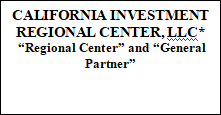
As noted in the organizational chart below, the entities and relationships described in this Memorandum are closely affiliated. More specifically regarding formation and the flow of funds, (i) the Company was established to undertake the Offering, to use the proceeds of the Offering to finance in part the entitlement, development and construction of the Project (as described herein), and (ii) the General Partner is the regional center and the general partner of the Company.
 OVERVIEW STRUCTURE




* The Regional Center will enable the Company to utilize its regional approval to create jobs and the General Partner will administer the Company. The Regional Center is California Investment Regional Center, LLC. CIRC is also the General Partner of the Company. The principals of CIRC (“Principals”) are Min (Michelle) Hu and Zhong (Johnson) Fang.
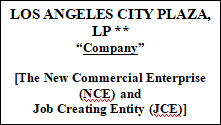
** The Company that will raise capital to fund the Project. The Company will utilize the Regional Center's designation in connection with the Investment, and whose Project will, in turn, create a sufficient number of jobs to satisfy the EB-5 Program requirements.
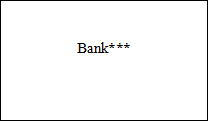
*** The Company intends to obtain or refinance a construction loan of approximately $12.5 million (the “Construction Loan“) from a financial institution (the “Construction Lender“). The Construction Loan will create a first priority deed of trust on the Project and will have the first priority in repayment over any other loans and repayment of the Investment.
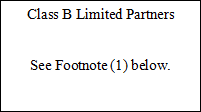
(1) Class A Limited Partners are EB-5 Investors who invested $6 million into the Company at $500,000 per Class A Limited Partnership Interest prior to the enactment of the Integrity Act.
(2) Class B Limited Partners are EB-5 Investors investing on or after the enactment of the Integrity Act at $800,000 per Unit (Class B Limited Partnership Interest). Excludes $70,000 per Unit for the Administrative Fee amount.
(3) The Company intends to enter into agreements with overseas migration consultants.
The Offering
The Company is seeking an aggregate amount of up to the Investment Amount (estimated to be $12 million) (the “Offering”) from Subscribers desiring to invest in the Company by purchasing Class B Limited Partnership Interests (“Units”). This Offering is made pursuant to an exemption from registration provided by Section 4(a)(2) of the Securities Act, and/or Regulations D and/or S promulgated thereunder, and exemptions available under applicable state securities laws and regulations. Persons desiring to acquire a Unit will be required to represent and warrant to the Company that (i) if the offer is made pursuant to Regulation S, they are not “U.S. Persons” as defined in Regulation S, (ii) if the offer is made pursuant to Regulation D, they either (y) qualify as an Accredited Investor as defined by the Securities Act or, (z) if a non-Accredited Investor, the Person has such knowledge and experience in financial and business matters that he/she is capable either on his/her own or together with his/her advisors and representatives to evaluate the merits and risks of investing in the Company as an Investor Partner.
We are not required to obtain a minimum amount of capital commitments before we consummate the initial closing of the purchase and sale of Units. In connection with or following the Company’s acceptance of your Subscription Agreement, it will send you wire instructions and check delivery instructions so you can deliver: (i) your capital contribution of US$800,000 (“Capital Contribution”) and (ii) your administrative fee of US$70,000 (“Administrative Fee”).
Upon the satisfaction of disbursement conditions as set forth in the Subscription Agreement, the Capital Contributions will be deposited directly into L.A. City Plaza’s (“LACP”) special designated bank account (“Capital Contribution Account”), administered by the fund administrator whom appointed by Zhong Fang, Majority owner of General Partner (CIRC) of LACP in accordance with the EB-5 Services Agreement. A copy of the EB-5 Services Agreement is attached as Exhibit E. The Fund Administrator also serves as a co-signatory of the Capital Contribution Account.
Upon the satisfaction of disbursement conditions as set forth in the Subscription Agreement, the Administrative Fee will be deposited into the special designated bank checking account of “California Investment Regional Center LLC” (“Operating Account”) and disbursed as set forth in the Partnership Agreement.
Your capital may be invested for an indefinite period of time. There are substantial risks associated with your investment and potential reinvestment of your investment capital into an Alternative Investment. Please see the section of this Memorandum entitled “Risk Factors.” There is no guarantee when or if funds will be available to return your Capital Contribution.
General Partner Compensation
The General Partner will receive the following compensation: (a) the General Partner will receive the portion, if any, of each Investor's Administrative Fee that is not paid to a Consultant (as defined in “Summary of Offering Terms”) in order to compensate the General Partner for its efforts associated with setting up and operating the Company and conducting the Offering; and (b) the General Partner will retain an ownership interest in the Company in excess of the 2% allocated to each Class A Limited Partner and Class B Limited Partner. As of the date hereof, the General Partner and the Class A Limited Partners (12 Investor Partners) own 76% and 24% interest, respectively, in the Company.
Initial Use of Proceeds
The Company will use the Offering proceeds to finance, in part, its development and operation of the Project all as described in further detail in this Memorandum, below.
A detailed budget is included in the Business Plan, included in this Memorandum as part of Exhibit A.
Financing
The Company estimates that the total capital required to finance the Project is approximately $37.57 million, including land value, hard and soft construction costs, financing and operating costs.
Accordingly, the Company has or will arrange financing from several sources, in addition to the Offering proceeds, in order to complete the construction and development of the Property, and thereafter successfully operate the Project. Approximately 33.27% of the total capital required to finance the Project is expected to be funded from bank financing, 18.82% from private equity, and 15.97% from the Class A Limited Partners. The remaining 31.94% of the total capital required to finance the Project is expected to be obtained from the Offering proceeds.
Reports to Investor Partners
The General Partner shall send at the Company’s expense to each Investor Partner the following: (a) after the end of each calendar year of the Company, such information as shall be necessary for the preparation by such Investor Partner of their federal income tax return which shall include a computation of the distributions of such Investor Partner and the allocation to such Investor Partner of profits or losses, as the case may be; (b) no less than annually (based on calendar years) the General Partner will provide to the applicable Investor Partners a status report on the Company’s investment in the Project; and (c) other information as deemed necessary by the General Partner to comply with immigration and securities laws. Other than the annual status reporting requirements set forth above, the General Partner may, but has no obligation to, respond to Investor Partner inquiries seeking interim status reports or updates regarding the Company. The financial information in all reports will be Company prepared compilations that will not be reviewed or audited by a certified public accountant.
Risk Factors
Acquiring a Unit involves various risks and uncertainties, including the risk of the loss of capital. You should carefully consider the risks described in “Risk Factors” and the other information in this Memorandum, before deciding whether to invest in the Units. The risks and uncertainties described below are not the only ones the Company may face but do represent those risks and uncertainties that the Company believes are material. Additional risks and uncertainties not presently known to the Company or that are currently deemed immaterial may also harm the business.
Conflicts of Interest and Duties of the General Partner
The General Partner has a legal duty to manage the Company in good faith. A determination, other action or failure to act by the General Partner will be deemed to be in good faith unless the General Partner believed such determination, other action or failure to act, was adverse to the Company. Conflicts of interest exist and may arise in the future as a result of the relationships between the General Partner and its affiliates, on the one hand, and the Company and Investor Partners, on the other hand.
To the extent permitted, the Company’s Partnership Agreement limits the liability of and replaces the duties owed by the General Partner to Investors under the California Uniform Limited Partnership Act of 2008 with the duties set forth in the Partnership Agreement. The Partnership Agreement also restricts the remedies available to Investor Partners for actions that might otherwise constitute a breach of the General Partner’s duties. By acquiring a Unit, the purchaser agrees to be bound by the terms of the Partnership Agreement, and each Investor will be treated as having consented to various actions and potential conflicts of interest contemplated in the Partnership Agreement that might otherwise be considered a breach of fiduciary or other duties under California law.
For a more detailed description of the conflicts of interest and duties of the General Partner, please read “Conflicts of Interest” and “Summary of the Partnership Agreement.” For a description of other relationships with our affiliates, please read “Material Interrelationships.”
* * * * *
SUMMARY OF OFFERING TERMS
The following is only a summary of certain of the information contained in this Memorandum and is qualified in its entirety by reference to the more detailed discussions contained in this Memorandum below, as well as to the exhibits hereto (all of which are incorporated fully herein by this reference). In the case of any conflict between the summary below and the more detailed discussion in the body of the Memorandum, the latter shall control. In the case of any conflict between the body of this Memorandum and the exhibits hereto, the exhibits shall control. Similarly, this Memorandum, its exhibits, and certain other documents related thereto have been initially written in the English language; in the event of any conflict between the original English versions and any translations into other languages, the former shall control. Capitalized terms used but not defined herein shall have the meaning set forth in the Partnership Agreement.
The Company, New Commercial Enterprise and Job Creating Entity (or “NCE” or “Offeror”) | Los Angeles City Plaza, LP is a California limited partnership with its principal place of business located at 1598 Long Beach Blvd., Unit 101, Long Beach, CA 90813. The Company was formed on November 20, 2013, and is a “new commercial enterprise” and “job creating entity” within the meaning of the EB-5 Program. The term of the Company commenced upon the filing by the General Partner of the Certificate of Limited Partnership with the Secretary of State of the State of California and shall continue until the Company is dissolved, wound up and terminated in accordance with the provisions of the Company’s Partnership Agreement and the California Act. |
General Partner and EB-5 Regional Center | The General Partner of the Company is California Investment Regional Center, LLC, a California limited liability company with its principal place of business located at 1598 Long Beach Blvd., Unit 101, Long Beach, CA 90813. The General Partner is also the regional center for the Project. |
EB-5 Regional Center Designation | EB-5 funding for the Project is sponsored by the General Partner, a regional center authorized by the United States Citizenship & Immigration Services (“USCIS”) under the “EB-5 Immigrant Investor Program” (the “EB-5 Program”) to establish and solicit investment from foreign investors under the EB-5 Program (the “Regional Center”). The Project is believed to be a qualifying investment under the EB-5 Program. On March 15, 2022, President Biden signed the EB-5 Reform and Integrity Act of 2022, which repealed the existing EB-5 law and authorized the availability of EB-5 visas for Regional Center investors through September 20, 2027 (the “Integrity Act”). On April 12, 2022, USCIS published a notice on its website stating that as a result of the repeal, regional centers (including the Regional Center for the Project) previously designated by USCIS are no longer authorized to operate as a regional center. USCIS further advised that all entities seeking regional center designation, such as the Regional Center for the Project, must provide USCIS with a request for designation along with a compliance policy and plan to comply with the new EB-5 Program requirements set forth in the Integrity Act. On June 24, 2022, the U.S. District Court for the Northern District of California in Behring Regional Center LLC v. Mayorkas, et al, 3:22-cv-02487, issued a preliminary injunction enjoining USCIS “from treating as deauthorized the previously designated regional centers.” Subsequently, USCIS has indicated on its website that it is complying with the court’s order and that previously designated regional centers are now able to file Form I-956F, Application for Approval of an Investment in a Commercial Enterprise. On August 24, 2022, USCIS entered into a Stipulation of Settlement with regional center plaintiffs, which was approved by the U.S. District Court for the Northern District of California on September 1, 2022 (the “Regional Center Designation Settlement”). Pursuant to the Regional Center Designation Settlement: · Previously Approved Regional Centers (including the Regional Center for the Project) did not lose their designation as a result of the Integrity Act, but must file Form I-956 by December 29, 2022, as an amendment, in order to continue to maintain the status as an approved regional center for purposes of sponsoring new projects and new investors under the Integrity Act. · Previously Approved Regional Centers (including the Regional Center for the Project) may file Forms I-956F for project approval immediately. Their operations, including the ability to file and receive adjudication of any other Forms, shall not be limited by the lack of adjudication of the Form I-956 and need not wait for approval of the Form I-956. · For purposes of obtaining the necessary Form I-956F receipt notice required to file an investor’s Form I-526E petition, if a Form I-956F receipt notice is not issued within ten (10) calendar days of physical delivery of a regional center’s Form I-956F filing, USCIS will accept the lockbox notice along with a copy of at least the first six (6) pages of the filed Form I-956F (Parts 1-5) in lieu of “the receipt number for the regional center’s Form I-956F.” In the event that a Previously Approved Regional Center does not receive a receipt or notice from USCIS within ten (10) calendar days of physical delivery of the Form I-956F, USCIS will accept proof of cashed check or credit card charge (along with regional center name, new commercial enterprise name, job creating entity name if available, and approximate Form I-956F filing date) for purposes of providing “the receipt number for the regional center’s Form I-956F.” If proof of cashed check or credit card charge is submitted with the Form I-526E, regional centers or investors will interfile the Form I-956F receipt notice along with investor petition receipt number(s) and investor name(s) once it becomes available. · Previously Approved Regional Centers (including the Regional Center for the Project) must file Form I-956F for previously approved exemplars (Form I-924) adjudicated prior to enactment of the Integrity Act if any investors associated with such Previously Approved Regional Center intend to file a Form I-526E petition after the enactment of the Integrity Act based on an investment into the offering and capital investment project described in the previously approved exemplar. Consistent with the Integrity Act, all aspects of the project previously approved in the I-924 amendment exemplar shall be binding for purposes of the new I-956F filing, unless one of the conditions enumerated in U.S.C. 1153(b)(5)(F)(ii)(I)-(V) is present. This does not apply to the new requirements imposed by the Integrity Act; USCIS may review any new elements and ask for additional clarification when needed under existing processes. Changes made to a business plan—or any other aspect of the approved exemplar—made to comply with the Integrity Act shall not constitute a material change. · If a Previously Approved Regional Center fails to file a Form I-956 application or amendment by December 29, 2022, it may no longer engage in any activities under the Integrity Act, including sponsoring I-526E petitions or the development of new projects. However, USCIS will continue to process and adjudicate I-526 and I-829 petitions from investors filed prior to the Integrity Act (as well as future I-829 petitions based on I-526 petitions filed prior to the Integrity Act) and this will not, standing alone, be a basis for USCIS to deny a petition described by the preceding sentence. Investors who filed their petitions prior to the Integrity Act are still subject to the provisions and protection of INA 203(b)(5)(m) should they become applicable. The Company and the Regional Center will diligently meet USCIS requirements on designation or certification, as applicable. The Company believes USCIS will approve the Regional Center’s compliance plan and designation or certification application, although there are no assurances. In the event USCIS does not approve such application, Investors will be unable to participate in the EB-5 Program through the Company and the Offering. |
General Partner Management | The General Partner is owned entirely by Zhong (Johnson) Fang and Michelle Hu, with its principal place of business located at 1598 Long Beach Blvd., Unit 101, Long Beach, CA 90813. |
Key Principal | The day-to-day operations of the General Partner is controlled by Zhong (Johnson) Fang, President and Chief Executive Officer of General Partner and Regional Center (the “Key Principal”). |
Investment Amount | “Investment Amount” means an equity contribution to Company in an amount of up to Twelve Million Dollars ($12,000,000) in exchange for Class B Limited Partnership Interests, but the General Partner reserves the right to increase the Investment Amount, provided there are sufficient jobs for EB-5 Program purposes to support such an increase. |
The Project | The Company was organized for the purposes of raising the Investment Amount or such greater or lesser amount as determined by the General Partner to be used to purchase, in one or more increments, to finance, in part, the development and operation of the Long Beach Homes Project which consists of a 4-story, approximately 90,200 square foot mixed-use development consisting of 4,800 square feet of retail space for lease, two restaurants totaling 5,256 square feet, at 36 residential condominium units for sale at 1598 Long Beach Boulevard, Long Beach, California 90813 (collectively, the “Project”). See “Description of the Project” below and Exhibit A for more detailed descriptions of the Project. |
Project Management | Development and construction of the Project will be the responsibility of the General Partner. |
Securities Being Offered: | Each Investor Partner (“Class B Limited Partner”) purchasing a Unit in this Offering is acquiring a Class B Limited Partnership Interest in the Company (“Class B Limited Partnership Interest”), the terms of which are set forth in the Partnership Agreement (as defined below). The Company raised $6 million from 12 Investor Partners (each a “Class A Limited Partners”) at $500,000 per limited partnership interest (“Class A Limited Partnership Interests”) prior to the enactment of the EB 5 Reform and Integrity Act of 2022 on March 15, 2022 (the “Integrity Act”). The Integrity Act repealed the then existing EB-5 law (“Prior EB-5 Law”) and authorized the availability of EB-5 visas for Regional Center investors through September 20, 2027. The Class A Limited Partners and the Class A Limited Partnership Interests are, to the extent required, governed by the Prior EB-5 Law. As of the date hereof, out of the 12 Class A Limited Partners that have filed their Form I-526 Petitions with USCIS, none have had their Form I-526 petitions approved, and none have had their Form I-526 petitions denied. None of the Class A Limited Partners have filed their Form I-829 petitions with USCIS. |
Minimum Investment | $800,000, each, a “Capital Contribution”. This Capital Contribution minimum amount reflects the Company’s opinion that the Project as of the date of the Offering is located within a “targeted employment area” as defined under the EB-5 Program. USCIS will determine whether the Project is located within a targeted employment area. Each Capital Contribution will be placed fully at risk in the job-creating activity of the Company. |
Use of Proceeds | The Company intends to use all of the proceeds of this Offering to finance and operate the Project as described herein. |
Administrative Fee | Each subscribing Investor shall pay an administrative fee of $70,000.00 (the “Administrative Fee” and together with the Capital Contribution, the “Subscription Amount”). All or a portion of each Investor’s Administrative Fee shall be paid to the special designated bank checking account of “California Investment Regional Center LLC”. The Administrative Fee shall be used by the General Partner to pay Start-Up Expenses (as defined below) to assure that the entirety of each Investor's $800,000.00 Capital Contribution is available to the Company for job creating activities. |
Subscription Amount | Upon acceptance of an Investor’s Subscription Agreement, such Investor will be admitted into the Company as an Investor Partner. Capital Contributions and Administrative Fees shall be deposited in special designated bank accounts. Upon the satisfaction of disbursement conditions as set forth in the Subscription Agreement, the Capital Contributions of $800,000 investment fund will be deposited directly into L.A. City Plaza’s (“LACP”) special designated bank account for EB-5 capital investment to be kept and used for items relating the necessary costs and expenses for the purpose of creating required jobs based upon the updated Business Plan in May 2023. The Fund Administrator shall be appointed by Zhong Fang, Majority owner of General Partner (CIRC) of LACP. The Fund Administrator also serves as a co-signatory of the Capital Contribution Account. Capital Contributions and Administrative Fees may be refunded as provided in the Subscription Agreement attached as Exhibit C. |
Investor Qualification | This Offering is made pursuant to an exemption from registration provided by Section 4(a)(2) of the Securities Act, and/or Regulations D and/or S promulgated thereunder, and exemptions available under applicable state securities laws and regulations. Persons desiring to invest in the Units will be required to represent and warrant to the Company that (i) if the offer is made pursuant to Regulation S, they are not “U.S. Persons” as defined in Regulation S, and (ii) if the offer is made pursuant to Regulation D, they either (y) qualify as an Accredited Investor as defined by the Securities Act or, (z) if a non-Accredited Investor, the Person has such knowledge and experience in financial and business matters that he/she is capable either on his/her own or together with his/her advisors and representatives to evaluate the merits and risks of investing in the Company as an Investor. |
Capital Accounts | Each Capital Contribution is credited to the contributing Investor’s Capital Account in exchange for the subscribed Units. Terms governing the maintenance of Capital Accounts are set forth in the Partnership Agreement (see Exhibit B). |
Additional Capital Contributions | Except as provided for in the Partnership Agreement, no Partner is under any obligation to make additional capital contributions to the Company beyond their initial Capital Contribution (see Exhibit B). |
Control (Limited Investor Partner Voting) | All management and other powers relating to day-to-day control of the Company will be held and exercised by the General Partner, to the maximum extent permitted by law. Investor Partners will have (i) the right to affect policy-making of the Company as set forth in the Partnership Agreement, and (ii) certain limited voting rights as set forth in the Partnership Agreement. |
Transfer Restrictions; No Resale | Units may not be transferred at any time prior to the expiration of such Investor Partner's Sustainment Period, nor thereafter without the consent of the General Partner, and then only in compliance with applicable securities laws and regulations. There are other substantial restrictions on transferring Units. No market for the Units exists, and no market is expected to develop. See “Risk Factors”, below. |
Allocation of Profits and Losses | Profits and losses of the Company shall be allocated to the Investor Partners as provided in the Partnership Agreement (see Exhibit B). |
Allocation of Jobs | The qualifying jobs created by the Company’s investment of the Offering proceeds in Company will be allocated to Investors on a first-in, first-out basis tied to the date on which an Investor commences his or her conditional lawful permanent residency, or by such other method as may be required or allowed by USCIS. At the time an Investor files his or her I-829 Petition, jobs will be allocated to that Investor and those allocated jobs will no longer be available for allocation to other Investor Partners. |
Distributions of Return on Investment | Generally speaking, the Company intends to make distributions of return on (but not of) investment to an individual Investor from net cash flow of the Company dating from and only from the utilization of such individual Investor’s Capital Contribution by the Company. If the Company makes such distributions, they shall be made, first, 2% to each Class A Limited Partner and Class B Limited Partner, on a pro-rata basis, up to a maximum of 54%, (based on 27 Investor Partners) and thereafter the balance, shall be distributed to the General Partner. For the protection and benefit of the Investor Partners, the Company will only wire Investor Partner distribution payments, and only if the Company has received a completed IRS Form W-8BEN or W-9 for such Investor Partner. In addition, the Company may elect to wire distribution payments directly to an escrow account to be held for an Investor’s benefit. The Company may exercise this right if, for example, and by way of illustration only, it determines that an Investor has not provided current contact information, or current bank account and wiring information, preferably for a U.S. bank. |
Distributions of Return of Investment | Upon a Capital Event, first, 2% to each Class A Limited Partner and Class B Limited Partner, on a pro-rata basis, up to a maximum of 54% (based on 27 Investor Partners), and thereafter the balance, if any, shall be distributed to the General Partner. Provided, however, if the Company acquires the Alternative Investment, such distributions shall not be made to an Investor Partner until such Investor Partner becomes eligible for distributions under the terms set forth in the Partnership Agreement. Each of the foregoing distributions is within the General Partner’s sole discretion and subject to certain restrictions as set forth in the Partnership Agreement. The ability to make the foregoing distributions is dependent on the success of the Project and there is no guarantee that any such distributions will be made. See “Risk Factors”, below. |
Commissions and Fees | As described above under “Administrative Fee”, each subscribing Investor shall pay an Administrative Fee of $70,000.00. All or a portion of each Investor's Administrative Fee shall be paid to one (1) or more Consultants, pursuant to the terms of one (1) or more Consulting Agreements. The portion of the Administrative Fee (up to the entire Administrative Fee) paid to a Consultant will be compensation paid by the Investor to the Consultant as a commission or fee for referring the Investor the opportunity to invest in the Company pursuant to this Offering. Any portion of the Administrative Fee not paid to a Consultant shall be retained by the General Partner. The portion, if any, of the Administrative Fee retained by the General Partner shall be used by the General Partner to pay Start-Up Expenses. Each Consultant is an immigration consultant; un-registered emigration agent and/or finder located, and with activities exclusively, outside the U.S. who are believed not to be required under applicable law to be SEC-registered advisors; registered broker- dealers; or other parties in connection with the sale of Units pursuant to this Offering. Any such commissions or other fees paid to any such party in connection with the sale of Units pursuant to this Offering, both currently and in the future, shall in no case be paid out of the proceeds of Capital Contributions of Investor Partners. The Administrative Fee paid by each Investor is not a Capital Contribution. If and to the extent that such commissions and fees payable to the Consultants under the Consulting Agreements exceed the Administrative Fee paid by the Investors, the General Partner shall pay the remaining balance of such commissions and fees from any source of revenue it may have, including, by way of illustration only, Net Distributable Cash the General Partner may receive from the Company. As of the date of this Memorandum, the General Partner and/or an affiliate of the General Partner has entered or is expecting to enter into one (1) or more Consulting Agreements with one or more Consultants outside the U.S., who are believed not to be required under applicable law to be SEC registered broker-dealers, or licensed broker-dealers under Section 15 of the Exchange Act and in good standing with the Financial Industry Regulatory Authority, and who are responsible for identifying prospective investors in connection with this Offering. The Consulting Agreements provide generally that the Consultants named in such agreements will provide consulting services for the Offering in exchange for a consulting fee, in compliance with applicable U.S. and foreign laws, including by way of illustration only, registering with USCIS to the extent USCIS adopts regulations requiring such registration. The Consulting Agreements may also provide that the Consultants will assist the General Partner and its affiliates in providing ongoing investor relations and immigration assistance to Investors in connection with their investment in the Company, in exchange for a consulting fee. Consulting fees may vary according to the terms of each individual Consulting Agreement. The General Partner and/or an affiliate may enter into additional Consulting Agreements after the date of this Memorandum. |
General Partner Compensation | The General Partner will receive the following compensation, none of which will be paid out of the Investment Amount: 1) The General Partner will receive the portion, if any, of each Investor's Administrative Fee that is not paid to a Consultant in order to compensate the General Partner for its efforts associated with setting up and operating the Company and conducting the Offering. 2) The General Partner will retain an ownership interest in the Company in excess of the 2% ownership interest allocable to each Class A Limited Partner and Class B Limited Partner (maximum 54% based on 27 Investor Partners). As of the date hereof, the General Partner and the Class A Limited Partners (12 Investor Partners) own 76% and 24% interest, respectively, in the Company. |
Company Expenses | The Company shall be responsible for all its normal, recurring daily Operating Expenses, including legal fees and litigation costs, reasonably incurred by the General Partner and the Company or on its behalf not reimbursed by the Company. The General Partner may advance sums to cover Company expenses, provided the Company has insufficient funds to cover such expenses. The Company shall reimburse the General Partner from the Company’s future revenue (to the extent and as soon as available) for any advanced expenses plus interest incurred thereon at an annual interest rate equal to the “prime rate” announced by the Wall Street Journal, plus two percent (2%). The portion, if any, of the Investors’ Administrative Fees retained by the General Partner shall be used by the General Partner to pay Start-Up Expenses (as defined below). To the extent Start-Up Expenses exceed the Administrative Fees, the General Partner will pay Start-Up Expenses from Net Distributable Cash it may receive from the Company. In no event will the Capital Contributions of the Investor Partners be used to pay Start-Up Expenses. “Start-Up Expenses” means all reasonable out-of-pocket expenses that are directly related to the marketing and sale of Units, including, but not limited to out-of-pocket marketing expenses, escrow expenses and commissions, filing fees, reasonable travel and entertainment expenses, and fees and expenses relating to the production of marketing materials. |
Tax Risks | Investment in the Company involves substantial tax risks. The Company has not obtained a legal opinion or ruling from any tax authority regarding any tax aspects of the Project, the Company, or its business. This tax discussion is not tax advice to Investors. Each Investor is advised to consult with his or her own tax advisor regarding the tax consequences of investing in the Company. See “Risk Factors” and “Tax Considerations”, below. |
Risk Factor | An investment in Units of the Company involves substantial risks, including reliance on management, general market risks, limited transferability of Units, reliance on the services of third parties, risks unique to the EB-5 Program, and other matters. There is no guarantee that an Investor shall receive either a return of his or her investment, or a return on his or her investment. See “EB-5 Immigration Disclosures and Risk Factors” and “Risk Factors”, below, for a discussion of some of these risks. |
Immigration Risks | Neither the Company nor the General Partner guarantees that any Investor will be granted an EB-5 visa or conditional or permanent residency in the United States as a result of their purchase of Units of the Company. Each Investor must evaluate and accept the risk that he/she may not be granted residency in the United States after making their Capital Contribution and being admitted as an Investor Partner of the Company. See “EB-5 Immigration Disclosures and Risk Factors” and “Risk Factors”, below. |
* * * * *
THE PROJECT
Project Overview
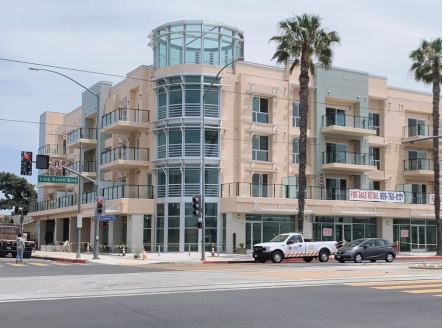
Los Angeles City Plaza, LP, a California limited partnership (“Company”) was formed by its General Partner, California Investment Regional Center, LLC, a California limited liability company (“CIRC” or “General Partner”) for the purpose of raising capital and developing, constructing and operating the Long Beach Garden Homes project which consists of a 4-story, approximately 90,200 square foot mixed-use development consisting of 4,800 square feet of retail space for lease, two restaurants totaling 5,256 square feet, 36 residential condominium units for sale, and 80 parking spaces (the “Project”) at 1598 Long Beach Boulevard, Long Beach, California 90813 (the “Property”).
The Company raised $6 million from 12 Investor Partners (“Class A Limited Partners”) at $500,000 per limited partnership interest (“Class A Limited Partnership Interests”) prior to the enactment of the EB5 Reform and Integrity Act of 2022 on March 15, 2022 (the “Integrity Act”). The Integrity Act repealed the then existing EB-5 law (“Prior EB-5 Law”) and authorized the availability of EB-5 visas for Regional Center investors through September 20, 2027. The Class A Limited Partners and the Class A Limited Partnership Interests are, to the extent required, governed by the Prior EB-5 Law. As of the date hereof, out of the 12 Class A Limited Partners that have filed their Form I-526 Petitions with USCIS, none have had their Form I-526 petitions approved, and none have had their Form I-526 petitions denied. None of the Class A Limited Partners have filed their Form I-829 petitions with USCIS.
The Company is now seeking to raise up to $12 million from 15 new EB-5 investors (“Class B Limited Partners”) at $800,000 per limited partnership interest (“Class B Limited Partnership Interests”). The Class B Limited Partners and the Class B Limited Partnership Interests are, to the extent required, governed by the Integrity Act.
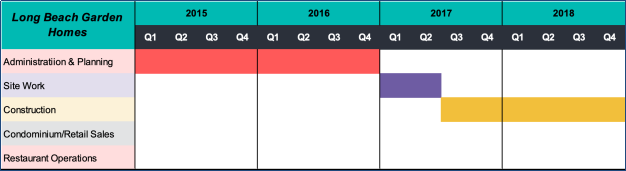
Construction of the Project began in January 2017 with Site Work. Progress was significantly delayed by the Covid-19 pandemic, but as of April 2022, building construction is substantially complete.
Project Financing
The Company anticipates that the Project will cost approximately $37.57 million, including the purchase price paid for the Property (as defined below), and will be financed through a combination of debt, equity, the Investment and other capital raised (or to be raised) by the Company for the Project.
The Project will be financed with approximately $7.07 million of financing from General Partner in the form of equity, $12 million from the Investment, $6 million from the Class A Limited Partners, and approximately $12.5 million from the Construction Lender. The Company may obtain Bridge Financing through equity or debt funding from a third party in order to commence the active development of the Project and repay any Bridge Financing in full with the proceeds of the Investment. In the event that the Company is unable to fund the Maximum Offering Amount, the Company will obtain an additional loan from a third party in lieu of the unfunded balance of the Investment. The Company is not required to obtain a minimum amount of capital commitments before it may consummate the initial closing of the purchase and sale of Units in this Offering.
Investors should be aware that the primary source of repayment of the Investment is expected to be the sale of condominiums, and there can be no assurance that the proceeds of operation or sale of the Property will be sufficient to repay the Investment. The repayment of the Investment will be junior to and subordinate to the Construction Loan. The development and operation of the Property will be subject to a number of risks, as further described in Section IV Risk Factors. If the value of the Property is not sufficient to repay the outstanding balance of the Construction Loan, the Investors are at risk of a loss of some or all of their investment in the Company.
A. General
Although the Company believes that the enclosed Executive Summary accurately reflects the current status of the Project and its development potential, there are no assurances that facts and circumstances will not arise that will necessitate a modification of the business plan set forth in the Executive Summary.
The Executive Summary contains financial projections related to the Project, which are subject to the “Forward-Looking Statements - Important Factors and Associated Risks” disclosure set forth herein.
B. Project Overview
“The Long Beach Garden Homes Project” is a $37.57 million dollar capital investment project that features a 4-story, approximately 90,200 square foot mixed-use development consisting of 4,800 square feet of retail space for lease, two restaurants totaling 5,256 square feet, 36 residential condominium units for sale, and 80 parking spaces. The Investment from the Company will provide the Company with a portion of the funding necessary to complete the construction of the Project and create the jobs in accordance with the Economic Study prepared by Baker Tilly below.
C. Project Description
The Project consists of one 4-story building. Once complete, the Project will consist of the following:
Land Area: 36,000 SF
Underground Parking: 32,000 SF
Underground Parking 80 stalls
Back Façade Ground Parking 43 stalls
Rentable Retail Space: 5,447 SF
Residential Units: 36 Units
One Bedroom Units: 1,000 SF each
Two Bedroom Units: 1,300 SF each
Restaurant:
Type: Full Service
Size: 4,553 SF
Amenities:
· Lobby
· Fitness Area
· Indoor Pool
· Hanging garden
Total Cost: $37.57 million
Upon construction completion, the Project will be conveyed into various condominium interests. The completed residential condominium parcels will be conveyed to the vested parties in fee simple title with an undivided interest in certain common areas, governed by a Master Owners’ Association. The Master Owners’ Association would be created for the purpose of ongoing management and maintenance of the common building areas and improvements. The residential condominium owners of the building will additionally receive an undivided interest in the residential common area under a subsidiary Residential Homeowners’ Association. Each condominium ownership entity will be responsible for paying monthly association dues.
D. Project Status
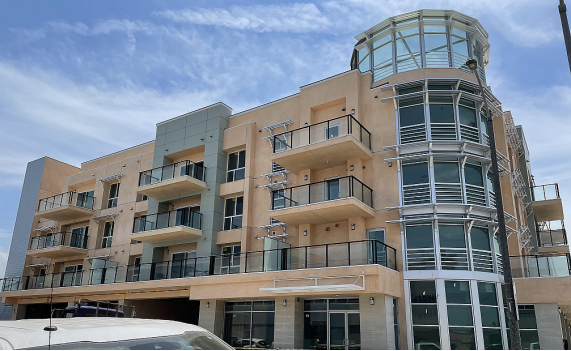
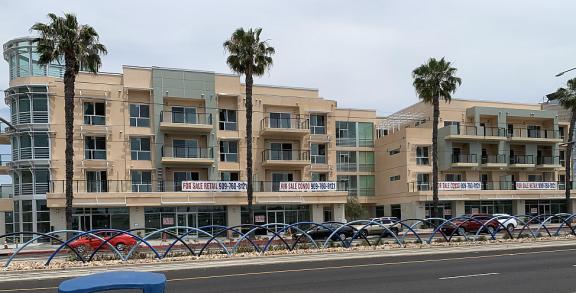
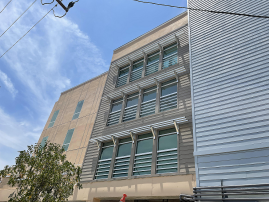
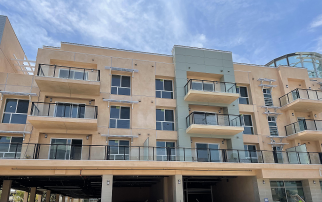
Construction of the Project began in January 2017 with Site Work. Progress was significantly delayed by the Covid-19 pandemic, but as of April 2022, building construction is substantially complete.
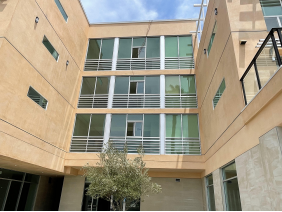
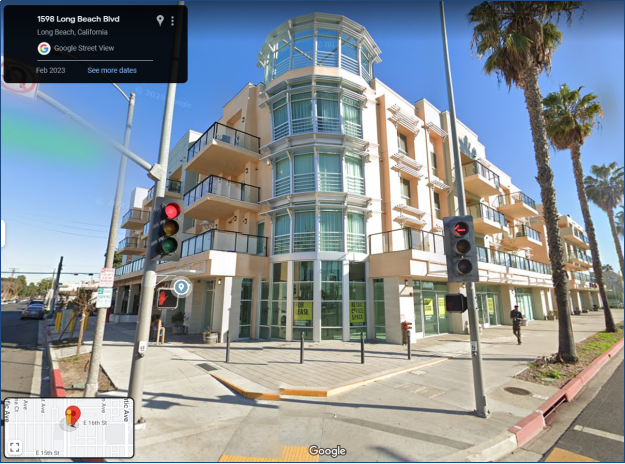
The following images show the current status of development, which is the substantial completion of building construction: Only interior construction for the restaurant and coffee shop, which is scheduled to occur from June 2024 to October 2024.

Condominium Unit Mix
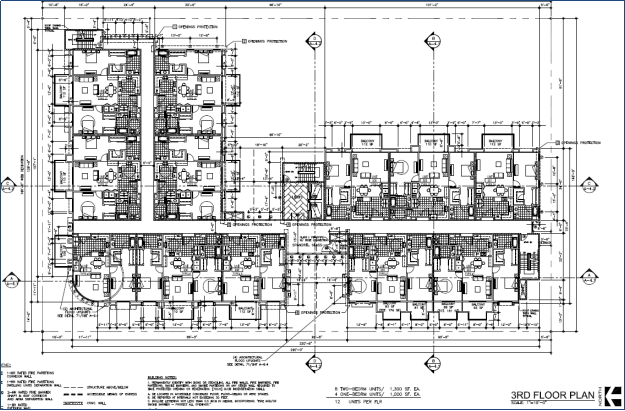
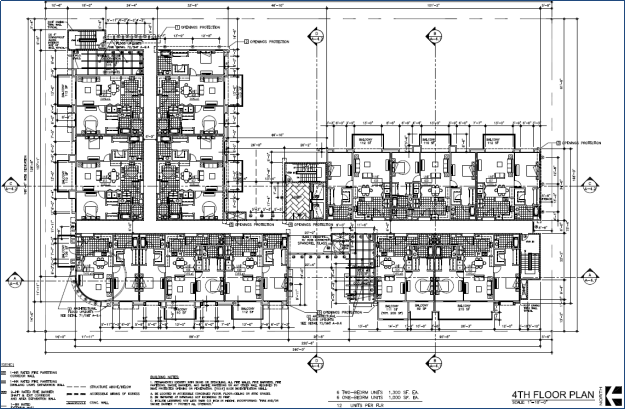
The following table provides a breakdown of unit mix by floor:
Residential Unit Mix by Floor | |||
Floor | One Bedroom Units | Two Bedroom Units | Total |
Second Floor (2nd) | 4 | 8 | 12 |
Third Floor (3rd) | 4 | 8 | 12 |
Fourth Floor (4th) | 4 | 8 | 12 |
Total: | 12 | 24 | 36 |
Renderings
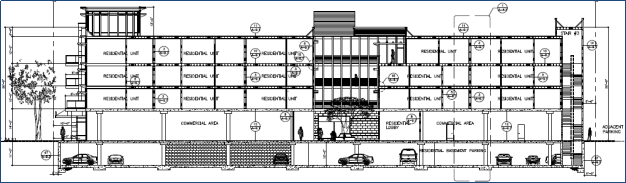
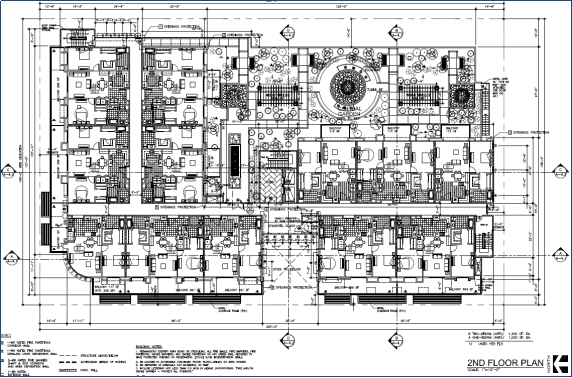
The residential units are located on the second, third, and fourth floors. The following images show the floor plans (Exhibit A):
The Long Beach Garden Homes Retail Floor
The first floor of the condominium building consists of 10,000 square feet (“SF”) of retail spaces for lease subdivided into 5 units, which is shown in the following floor plan:








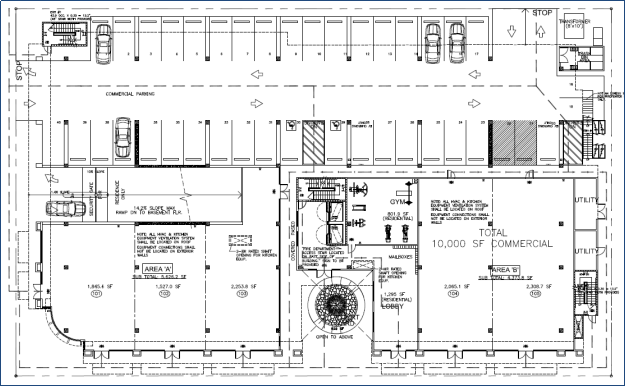
The retail portion will feature a full-service restaurant and a coffee shop, both of which will be owned and operated by the Company.
E. The Property
The Long Beach Garden Homes Project is a unique $37.57 million mixed-use development, conceived as a catalyst for the growth in Long Beach’s burgeoning downtown District. The Project includes a synergistic mix of urban housing and retail.
Program Highlights
The Long Beach Garden Homes Project is conceived as a 4-story, approximately 90,200 square foot mixed-use development consisting of 4,800 square feet of retail space for lease, two restaurants totaling 5,256 square feet, 36 residential condominium units for sale, and 80 parking spaces. The proposed development program includes a targeted mix of complementary uses that address several significant neighborhood, District and regional needs.
· Residential
The Long Beach Garden Homes Project will offer 36 units of well-designed, high-density, and entry-level condominiums to suit the needs of first-time buyers. Compact, efficient, creative space with abundant north light, high ceilings, and efficient open floor plans will be designed with students and professionals in mind. Common areas will provide collaborative space to engage with neighbors.
· Retail
The Long Beach Garden Homes Project will include over 4,800 square feet of ground-floor retail and entertainment space including food, shopping, and neighborhood services. Retail tenants will be carefully selected to provide a dynamic mix of high-quality, local products, food and amenities for residents and visitors alike. The retail space will be designed to provide a high degree of transparency to the surrounding streets and to draw pedestrian traffic from other nearby retail centers.
· Coffee Shop
The Long Beach Garden Homes Project coffee shop will consist of a total indoor area of 1,845 square feet, occupying unit 101 as indicated in the floor plan. The coffee shop will primarily serve coffee, tea, pastries, and baked goods. The coffee shop will be owned and operated by the Company.
· Restaurant
The Long Beach Garden Homes Project restaurant will consist of a total indoor area of 3,780.8 square feet, occupying units 102 and 103 as indicated in the floor plan. The full-service restaurant will primarily serve Chinese food such as dim sum, steamed buns, noodle delicacies, and other Chinese specialty dishes. The restaurant will be owned and operated by the Company.
· Space for Lease
Units 104 and 105 will be sold for retail or restaurant use by new owner(s).
OFFERING PROCEEDS AND OTHER SOURCES OF CAPITAL
The Company estimates that the total capital required to finance the Project is approximately $37.57 million, including land value, hard and soft construction costs, and financing costs.
Accordingly, the Company has or will arrange financing from three sources, in addition to the Offering proceeds, in order to complete the construction and development of the Property, and thereafter successfully operate the Project. Approximately 33.27% of the total capital required to finance the Project is expected to be funded from senior bank financing, 18.82% from private equity, and $6 million from Class A Limited Partners. The remaining 31.94% of the total capital required to finance the Project is expected to be obtained from the $12 million in Offering proceeds.
Sources | Amount | Percent |
Class A Limited Partners (EB-5) | $6,000,000 | 15.97% |
Class B Limited Partners (EB-5) | $12,000,000 | 31.94% |
Senior Debt | $12,500,000 | 33.27% |
Private Equity | $7,070,000 | 18.82% |
Total | $37,570,000 | 100.00% |
OWNERSHIP OF THE PROPERTY
The Property is owned by the Company.
PROJECT DEVELOPMENT SCHEDULE
Construction of the Project began in January 2017 with Site Work. Progress was significantly delayed by the Covid-19 pandemic, but as of April 2022, building construction is substantially complete. Only interior construction for the restaurant and coffee shop, which is scheduled to occur from June 2024 to October 2024. The following charts illustrate the entire Project schedule from initial planning in 2015 to Project completion:
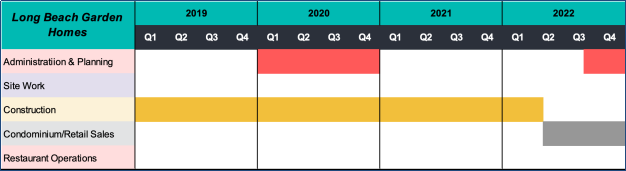
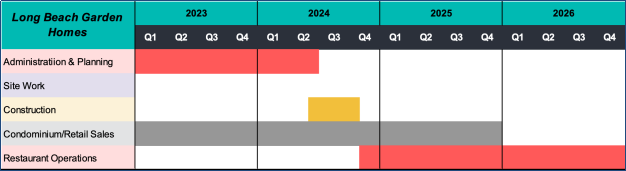
The following have been completed as of April 2023:
· Site Plan Approval received June 2015
· Foundation Permit received December 2016
· Site Work Commenced January 2017
· Site Work Completed October 2017
· Building Permit received October 2017
· Building Construction Commenced November 2017
· Framing commenced January 2018
· No Construction during 2020 due to COVID-19 restrictions
· Building Construction re-commenced 2021
o Progress slowed due to city inspection scheduling.
· Building Construction and Inspections Completed April 2022
The following are planned milestones required to complete the Project in its entirety:
· Sales of remaining condominium units.
· Sales of remaining retail spaces.
· Planning and submission of floor plans for restaurant and coffee shop (in progress).
· Receipt of building permits for interior improvements (anticipated June 2024).
· Commence construction of restaurant and coffee shop interiors (anticipated June 2024).
· Completion of improvements is anticipated in October 2024.
· Operation commencement of restaurant and coffee shop anticipated November 2024.
FINANCIAL PERFORMANCE PROJECTIONS
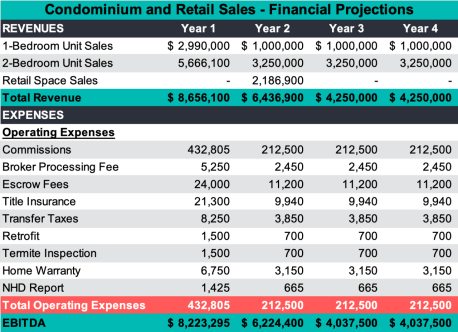
The Project will generate revenue from the sale of the condominiums, retail space, and operations of the coffee shop and restaurant.
The following table summarizes the update to the JCE’s projected pro forma for the sale of condominiums and retail spaces:
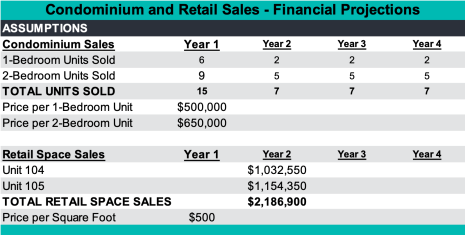
The Company is basing its condominium and retail space sales revenue on the following assumptions:
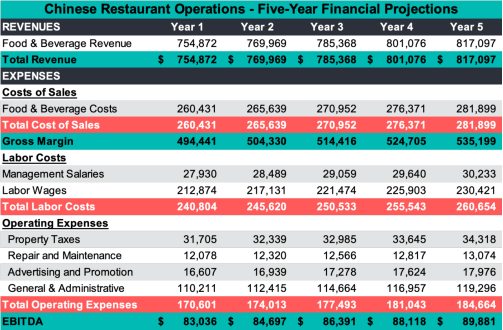
Chinese Restaurant
The following table summarizes the update to the Company’s projected operating pro forma for the new Chinese Restaurant:
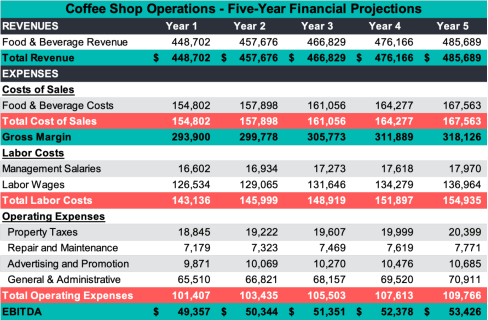
Coffee Shop
The following table summarizes the update to the Company’s projected operating pro forma for the Coffee Shop:
ECONOMIC ANALYSIS/JOB CREATION
Baker Tilly US, LLP (“Baker Tilly”), was retained to conduct an economic analysis of the Project. Baker Tilly’s report (the “Jobs Report”) is available upon request. Baker Tilly based the employment impacts of the Project on construction and revenue projections. The overall employment projections, including direct, indirect and indirect and induced jobs, have been developed using the RIMS II input-output model and total 383.7 direct and induced jobs resulting from construction, combined with direct, indirect and induced jobs from apartment operations, as shown in the table below:
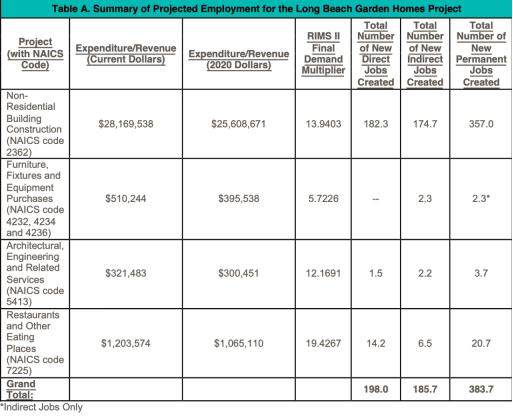
Overview of Project Job Creation
The Jobs Report was undertaken to (i) determine the current and potential future demand for the operation of an condominium complex in the market area for the Project, (ii) evaluate the share of the market that could be reasonably attained by the proposed Project assuming the total investment amount (including contributions from both Class A Limited Partners and Class B Limited Partners) is contributed to Company, and (iii) assess the potential future creation of jobs (including indirect and induced jobs) linked to the development and operation of the Project. As in all studies of this type, the estimated results assume competent and efficient management, and additionally assume no significant change in the competitive market from that set forth in the Jobs Report. Since the Jobs Report results are based upon estimates and assumptions that are subject to change, Baker Tilly does not represent them as results that will actually be achieved. It is expressly understood that the scope of the study and the report thereon do not include the possible impact of zoning or environmental regulations, licensing requirements, or other restrictions concerning the Project, except where such matters are expressly addressed and disclosed in the Jobs Report. See “EB-5 Immigration Disclosures and Risk Factors” below.
TARGETED EMPLOYMENT AREA (“TEA”)
EB5AN was retained to conduct an analysis of the Project’s eligibility for Targeted Employment Area (“TEA”). It issued a letter, dated January 20, 2023, concluding that this Project will qualify for TEA as high unemployment area under the Integrity Act. Specifically, based on current labor statistics, the project is located in a group of _____ (__) contiguous and directly adjacent census tracts in which the unemployment rate is higher than 150% of the national average unemployment rate.
A high unemployment area TEA is defined under the Integrity Act as the following:
· A TEA may consist of a single census tract or a configuration of contiguous census tracts in which the unemployment rate is at least 150 percent of the national average.
· Cities or towns with a population of 20,000 or more outside of a Metropolitan Statistical Area (“MSA”) may qualify as a TEA based on high unemployment as determined by The Department of Homeland Security (DHS).
The unemployment rate can be calculated by utilizing government sources of unemployment data such as the U.S. Census Bureau’s American Community Survey (ACS) and Local Area Unemployment Statistics data. As of the date of this Memorandum, the qualifying unemployment rate utilizing the census share method is 8.25%.
The address of the Project is 1598 Long Beach Boulevard, Long Beach, California 90813, Los Angeles County, Census Tract 5753. The following chart and map used in the analysis of the Project’s TEA eligibility show the unemployment data and location of the contiguous and directly adjacent census tracts, which are based on current unemployment data provided by U.S. Census Bureau:
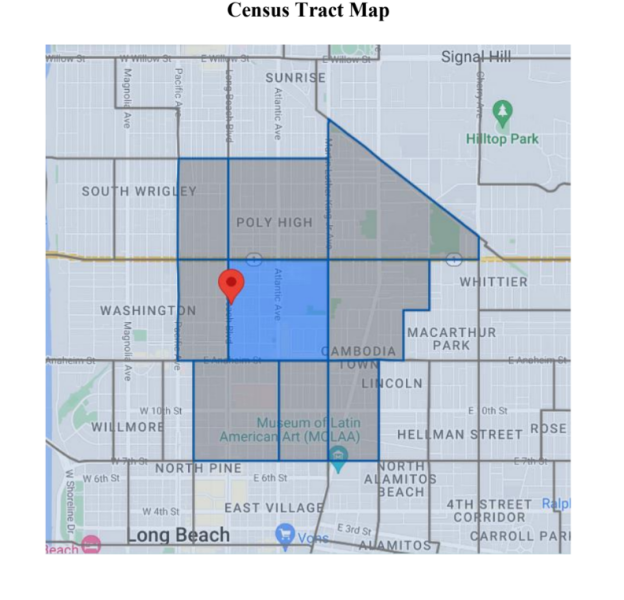
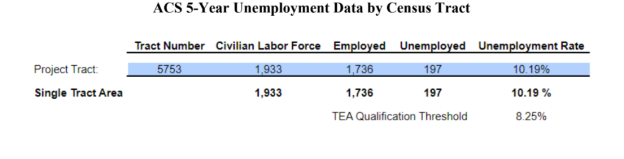
Based upon EB5AN’s interpretation of the TEA designation regulations and current data provided by U.S. Census Bureau, this Project will qualify for TEA with a 10.19% unemployment rate and utilizes directly adjacent census tracts only.
* * * * *
THE OFFERING
The Offering consists of an aggregate of up to 15 Units (Class B Limited Partnership Interest), at a per Unit price of $800,000, and an aggregate maximum investment of $12,000,000, offered on a “best-efforts” private placement basis. Provided, however the General Partner may close the Offering prior to raising $12,000,000, or increase the size of the Offering, each in its sole and absolute discretion. Each subscription must be for a minimum of 1 Unit for a minimum investment of $800,000. The Company will not accept subscriptions for fractional interests of the Units or investments that do not satisfy the minimum investment requirement of $800,000. The General Partner may accept or reject any subscription in its sole and absolute discretion.
Offers are made only by the Company’s delivery of this Memorandum and in a manner that meets the requirements for a non-public offering of securities under Section 4(a)(2) of the Securities Act and the applicable rules and regulations promulgated thereunder such as Regulation S and Regulation D, and/or under other applicable securities laws and regulations of the United States and/or applicable U.S. state or foreign country, and/or exemptions therefrom. No offering of the Units shall be made by any advertisement, article, or other communication published in a newspaper, magazine, or similar media, or broadcast over television or radio, or at a seminar or meeting attended by persons who have been invited by a general solicitation or general advertising; and shall be made only pursuant to a registration exemption under the Securities Act.
For Subscribers acquiring a Unit pursuant to Regulation D, such Subscribers must represent and warrant, in general, that they either (a) qualify as an Accredited Investor as defined by Regulation D promulgated pursuant to the Securities Act or, (b) if a non-Accredited Investor, the Subscriber has such knowledge and experience in financial and business matters that he/she is capable either on his/her own or together with his/her advisors and representatives to evaluate the merits and risks of investing in the Company as an Investor Partner. Such Subscribers must further represent and warrant that (i) that they are purchasing the Units for investment purposes only, and not with a view toward resale or distribution, and (ii) they shall not resell the Units except pursuant to registration under the Securities Act, or pursuant to an available exemption from registration.
For Subscribers outside the United States acquiring a Unit pursuant to Regulation S, such Subscribers must represent and warrant, in general, that they are not U.S. Persons, and that they are purchasing the Units (i) for themselves, and not for the account or benefit of any U.S. Person; and (ii) for investment purposes only, and not with a view toward resale or distribution. Such Subscribers must further represent that they shall resell the Units only in accordance with the provisions of Regulation S under the Securities Act, and not in the United States or to U.S. Persons except pursuant to registration under the Securities Act, or pursuant to an available exemption from registration; and that they shall not engage in hedging transactions with regard to the Units unless in compliance with the Securities Act.
Transfer of the Units is subject to U.S. federal and state securities laws and the securities laws of any applicable country, the requirement of prior approval of the General Partner in accordance with the terms of the Partnership Agreement, and other substantial restrictions on transfer set forth in the Partnership Agreement, including, without limitation, the adjudication of each Investor’s I-829 petition. See “Risk Factors”, below.
The General Partner may, in its sole and absolute discretion, cancel, terminate, close, or extend the Offering at any time. In the event the Offering is canceled or terminated, the General Partner shall return Subscription Amounts to each subscriber and notify the Regional Center for purposes of the Regional Center’s notification to USCIS of such return of capital, which probably would result in revocation of any immigration benefits obtained. The Company may waive any of the requirements set forth above, provided the General Partner remains in compliance with the Securities Act and the applicable rules and regulations promulgated thereunder, other applicable securities laws and regulations of the United States and applicable U.S. states and foreign countries, or exemptions therefrom.
The proceeds from the Capital Contribution will be deposited into the Los Angeles City Plaza Limited Partnership (“LP”) directly. Upon the satisfaction of deposit the LP will issue a receipt plus a Certificate of One (1) Unit ownership to the Investor. The LP shall be a New Commercial Enterprises (“NCE”) as well as a Job Creation Entity (“JCE”) create jobs to meet the EB-5 rules and regulations A copy of the EB-5 Services Agreement attached as Exhibit D.
The General Partner reserves the right to accept or reject any subscription for any reason in its sole and exclusive discretion. As stated above, any Capital Contributions not accepted will be returned without interest or deduction.
There is no firm commitment by any person to purchase or sell any Units, and there is no assurance that any of the Units will be sold.
NO ASSURANCE OF RETURN
The investment in the Company and in the Project is highly speculative, and subject to substantial risk. While investing and maintaining at-risk capital is a requirement to qualify for the EB-5 Program, it is also possible that the Investor Partners will not receive any distributions. Furthermore, it is possible that the Investor Partners could lose their entire investment.
EXIT STRATEGY
The Company’s anticipated sources of revenue will be distributions received from retail operations and sales of condominiums in the Project. There is no guarantee that the operation of the Project will generate adequate proceeds to return the Investment Amount, or that such a sale or refinance will be consummated on acceptable terms, if at all. The purchase of the Units is a long-term investment.
* * * * *
STATEMENTS REGARDING FORWARD LOOKING INFORMATION
We make statements in this Memorandum that are forward-looking statements within the meaning of the federal securities laws. The words “believe”, “estimate”, “expect”, “anticipate”, “intend”, “plan”, “seek”, “may”, and similar expressions or statements regarding future periods are intended to identify forward-looking statements.
These forward-looking statements involve known and unknown risks, uncertainties and other important factors that could cause our actual results, performance or achievements, or industry results, to differ materially from any predictions of future results, performance or achievements that we express or imply in this Memorandum or in the information incorporated by reference into this Memorandum.
The forward-looking statements included in this Memorandum are based upon our current expectations, plans, estimates, assumptions and beliefs that involve numerous risks and uncertainties. Assumptions relating to the foregoing involve judgments with respect to, among other things, future economic, competitive and market conditions and future business decisions, all of which are difficult or impossible to predict accurately and many of which are beyond our control. Although we believe that the expectations reflected in such forward-looking statements are based on reasonable assumptions, our actual results and performance could differ materially from those set forth in the forward-looking statements. Factors which could have a material adverse effect on our operations and future prospects include, but are not limited to:
• the effects of a global pandemic such as COVID-19;
• our ability to effectively deploy the proceeds raised in this Offering;
• risks associated with breaches of our data security;
• changes in economic conditions generally and the real estate and securities markets specifically;
• intense competition in the real estate market that may limit Company’s ability to attract or retain condominium purchasers and tenants or re-lease space;
• defaults on or non-renewal of leases by tenants;
• increased interest rates and operating costs;
• failure to obtain necessary outside financing;
• decreased rental rates or increased vacancy rates;
• failure to successfully operate the Project;
• exposure to liability relating to environmental and health and safety matters;
• changes in real estate and zoning laws and increases in real property tax rates;
• failure of the Project to yield anticipated results;
• leverage and debt levels;
• our ability to retain executive officers and other key personnel;
• our ability to retain and hire competent employees and appropriately staff our operations;
• legislative or regulatory changes impacting our business;
• changes in business conditions and the market value of our limited partnership interests, including changes in interest rates, prepayment risk, operator or borrower defaults or bankruptcy, and generally the increased risk of loss if the Project fails to perform as expected;
• our compliance with applicable local, state and federal laws, including the Investment Advisers Act of 1940, as amended, the Investment Company Act and other laws; and
• changes to generally accepted accounting principles, or GAAP.
Any of the assumptions underlying forward-looking statements could be inaccurate. You are cautioned not to place undue reliance on any forward-looking statements included in this Memorandum. All forward-looking statements are made as of the date of this Memorandum and the risk that actual results will differ materially from the expectations expressed in this Memorandum will increase with the passage of time. Except as otherwise required by the federal securities laws, we undertake no obligation to publicly update or revise any forward-looking statements after the date of this Memorandum, whether as a result of new information, future events, changed circumstances or any other reason. In light of the significant uncertainties inherent in the forward-looking statements included in this Memorandum, including, without limitation, the risks described under “Risk Factors”, the inclusion of such forward-looking statements should not be regarded as a representation by us or any other person that the objectives and plans set forth in this Memorandum will be achieved.
* * * * *
MANAGEMENT, ADVISORS, AND CONSULTANTS
Development Team
General Partner
California Investment Regional Center, LLC (“CIRC”)is the General Partner of the Company. CIRC will manage the Project via a team of individuals as indicated below.
Mr. Zhong (Johnson) Fang is the managing member of CIRC. From 1993 to 2013, Mr. Fang has been engaging in real estate development and project investment, management, and operations. Mr. Fang has experience specializing in marketing and construction. Mr. Fang is the spouse of Min (Michelle) Hu.
Ms. Min (Michelle) Hu is the managing member of CIRC. Ms. Hu graduated from the Department of Business Administration of the Wuhan University in China. Ms. Hu also attended Pasadena City College for further education. From 2000 to 2004, Ms. Hu had experienced a large scale of sales and administration of commercial and residential projects in China. From 2004 to 2013, Ms. Hu engaged in real estate sales and development as well as an immigration consultant service in California. Ms. Hu is the spouse of Mr. Zhong (Johnson) Fang.
General Contractor
USA Realty Construction Group Inc., a California corporation, is the general contractor for the Project and is affiliated with the General Partner and its Principals.
Regional Center
California Investment Regional Center, LLC is also the Regional Center for the Project. CIRC was organized on June 18, 2012 and was granted an initial designation as an approved Regional Center by the USCIS on May 28, 2015, as amended. The Regional Center is the holder of the USCIS-approved regional center rights to sponsor and administer qualified projects under the EB-5 Program in its approved geographic area and contiguous areas. CIRC will oversee the Project and perform the responsibilities of the USCIS regional center. The approval of a regional center means USCIS recognizes the economic entity as a designated participant in the EB-5 Program.
On March 15, 2022, President Biden signed the EB-5 Reform and Integrity Act of 2022, which repealed the existing EB-5 law and authorized the availability of EB-5 visas for Regional Center investors through September 20, 2027 (the “Integrity Act”). On April 12, 2022, USCIS published a notice on its website stating that as a result of the repeal, regional centers (including the Regional Center for the Project) previously designated by USCIS are no longer authorized to operate as a regional center. USCIS further advised that all entities seeking regional center designation, such as the Regional Center for the Project, must provide USCIS with a request for designation along with a compliance policy and plan to comply with the new EB-5 Program requirements set forth in the Integrity Act. On June 24, 2022, the U.S. District Court for the Northern District of California in Behring Regional Center LLC v. Mayorkas, et al, 3:22-cv-02487, issued a preliminary injunction enjoining USCIS “from treating as deauthorized the previously designated regional centers.” Subsequently, USCIS has indicated on its website that it is complying with the court’s order and that previously designated regional centers are now able to file Form I-956F, Application for Approval of an Investment in a Commercial Enterprise.
On August 24, 2022, USCIS entered into a Stipulation of Settlement with a few regional center plaintiffs which was approved by the U.S. District Court for the Northern District of California on September 1, 2022 (the “Regional Center Designation Settlement”). Pursuant to the Regional Center Designation Settlement:
· Previously Approved Regional Centers (including the Regional Center for the Project) did not lose their designation as a result of the Integrity Act, but must file Form I-956 by December 29, 2022, as an amendment, in order to continue to maintain the status as an approved regional center for purposes of sponsoring new projects and new investors under the Integrity Act.
· Previously Approved Regional Centers (including the Regional Center for the Project) may file Forms I-956F for project approval immediately. Their operations, including the ability to file and receive adjudication of any other Forms, shall not be limited by the lack of adjudication of the Form I-956 and need not wait for approval of the Form I-956.
· For purposes of obtaining the necessary Form I-956F receipt notice required to file an investor’s Form I-526E petition, if a Form I-956F receipt notice is not issued within ten (10) calendar days of physical delivery of the regional center’s Form I-956F filing, USCIS will accept the lockbox notice along with a copy of at least the first six (6) pages of the filed Form I-956F (Parts 1-5) in lieu of “the receipt number for the regional center’s Form I-956F.” In the event that a Previously Approved Regional Center does not receive a receipt or notice from USCIS within ten (10) calendar days of physical delivery of the Form I-956F, USCIS will accept proof of cashed check or credit card charge (along with regional center name, new commercial enterprise name, job creating entity name if available, and approximate Form I-956F filing date) for purposes of providing “the receipt number for the regional center’s Form I-956F.” If proof of cashed check or credit card charge is submitted with the Form I-526E, regional centers or investors will interfile the Form I-956F receipt notice along with investor petition receipt number(s) and investor name(s) once it becomes available.
· Previously Approved Regional Centers (including the Regional Center for the Project) must file Form I-956F for previously approved exemplars (Form I-924) adjudicated prior to enactment of the Integrity Act if any investors associated with such Previously Approved Regional Center intend to file a Form I-526E petition after the enactment of the Integrity Act based on an investment into the offering and capital investment project described in the previously approved exemplar. Consistent with the Integrity Act, all aspects of the project previously approved in the I-924 amendment exemplar shall be binding for purposes of the new I-956F filing, unless one of the conditions enumerated in U.S.C. 1153(b)(5)(F)(ii)(I)-(V) is present. This does not apply to the new requirements imposed by the Integrity Act; USCIS may review any new elements and ask for additional clarification when needed under existing processes. Changes made to a business plan—or any other aspect of the approved exemplar—made to comply with the Integrity Act shall not constitute a material change.
· If a Previously Approved Regional Center fails to file a Form I-956 application or amendment by December 29, 2022, it may no longer engage in any activities under the Integrity Act, including sponsoring I-526E petitions or the development of new projects. However, USCIS will continue to process and adjudicate I-526 and I-829 petitions from investors filed prior to the Integrity Act (as well as future I-829 petitions based on I-526 petitions filed prior to the Integrity Act) and this will not, standing alone, be a basis for USCIS to deny a petition described by the preceding sentence. Investors who filed their petitions prior to the Integrity Act are still subject to the provisions and protection of INA 203(b)(5)(m) should they become applicable.
The Company and the Regional Center will diligently meet USCIS requirements related to maintaining designation or certification, as applicable. The Company believes USCIS will approve the Regional Center’s compliance plan and designation or certification application, although there are no assurances. In the event USCIS does not approve such application, Investors will be unable to participate in the EB-5 Program through the Company and the Offering.
Economic Impact Consultant | Baker Tilly US, LLP
Baker Tilly’s EB-5 team provides consulting services specializing in economic studies, business plans, regional center operational plans, and TEA analysis. Baker Tilly has successfully prepared over 1,200 economic studies to evaluate and summarize the job-creation and economic impact attributed to regional center and individual EB-5 projects. Baker Tilly’s methodologies and economic research are well-vetted and considered to be in accordance with the best practices and standards of professional economists nationwide.
* * * * *
MATERIAL INTERRELATIONSHIPS
General Partner
The General Partner/Regional Center is owned entirely by Mr. Zhong (Johnson) Fang and Min (Michelle) Hu. Mr. Fang is the spouse of Min (Michelle) Hu. Mr. Zhong (Johnson) Fang is also the owner of USA Realty Construction Group Inc., the general contractor of the Project.
* * * * *
CONFLICTS OF INTEREST AND DUTIES OF GENERAL PARTNER
Conflicts of interest exist and may arise in the future as a result of the relationships between the General Partner and its affiliates, on the one hand, and the Company and Investor Partners, on the other hand. The managers and officers of the General Partner have fiduciary duties to manage the General Partner in a manner beneficial to the Company’s equity holders. At the same time, the General Partner has a duty to manage the Company in good faith. The Partnership Agreement specifically defines the remedies available to Investor Partners for actions taken that, without these defined liability standards, might constitute breaches of fiduciary duty under applicable California law. The California Uniform Limited Partnership Act of 2008, which we refer to as the California Act, provides that California limited partnerships may, in their Partnership Agreements, expand, restrict or eliminate the fiduciary duties otherwise owed by the General Partner to the Investor Partners and the Company. As a result of provisions in the Partnership Agreement of the Company, the General Partner will not, to the extent permitted, be subject to fiduciary duties to the Investor Partners that would otherwise arise under the California Act.
Whenever a conflict arises between our General Partner or its affiliates, on the one hand, and the Company and the Investor Partners, on the other hand, the resolution or course of action in respect of such conflict of interest shall be permitted and deemed approved by all Investor Partners and shall not constitute a breach of the Partnership Agreement, or of any agreement contemplated thereby or of any duty.
Because of shared ownership and commonality of financial interest, any transaction between the Company and (a) the General Partner and (b) the owners, managers, directors, officers, or employees of the General Partner may be entered into without the benefit of “arms-length” bargaining, and may involve actual or potential conflicts of interest. (See Paragraph 5, “Fiduciary Duties”, below).
The following constitutes a summary of important areas in which the interests of the General Partner or its members, managers, or officers may conflict with those of the Company and Investor Partners:
1. Lack of Independent Representation. The Offeror has not been represented by independent counsel. The attorneys that provide services relating to the Offering perform their services for the General Partner at its direction. There is no attorney-client relationship or legal representation of the Offeror itself.
2. The Management of the General Partner has a Fiduciary Duty to Make Decisions in the Best Interests of the Owners of the General Partner, Which May be Contrary to the Interests of the Company and the Investor Partners. The managers of the General Partner have fiduciary duties to the General Partner that may cause them to pursue business strategies that disproportionately benefit the General Partner or which otherwise are not in the best interests of the Company and Investor Partners.
3. Control of Offeror. Subject to significantly limited oversight by the Investors as Investor Partners of Offeror, the General Partner will be solely responsible for making all decisions of the Offeror pertaining to the investment of the Offering proceeds and the results therefrom. Additionally, the General Partner is generally responsible by the terms of the Partnership Agreement for the operations of the Offeror, including carrying out the specific authorization to invest the Offering proceeds on behalf of the Offeror in the Company.
4. Offeror Opportunities. The General Partner and its members, managers, officers, and their respective affiliates have previously had presented to it and/or to them opportunities to launch, and have launched, other investment vehicles for the pursuit of other investment or funding opportunities, both
Initial________
under the EB-5 Program and otherwise. Additionally, by reason of the General Partner’s management of the Offeror, including in particular the successful raise and investment of the Offering proceeds as contemplated by this Memorandum, the General Partner and its members, managers, officers, and their respective affiliates may have presented to it and/or to them in the future, additional opportunities to launch other investment vehicles for the pursuit of other investment or funding opportunities, and to participate in other real estate development projects, both under the EB-5 Program and otherwise, which might not otherwise have been made available to it or and/to them. Each Investor should recognize that the General Partner (or another legal entity formed by the General Partner and/or its member and principals directly) intends to investigate such opportunities, and may, in consequence, undertake to manage, participate in, develop, own, or acquire other future investment projects, as well as continue those same activities with regard to existing investment projects, all whether or not similar to the Project, and conceivably competitive therewith, for its own account, or for the account of others. Any investment projects so managed, developed, owned, or acquired by or participated in by the General Partner or its affiliates (or continuing to be managed, developed, owned, or acquired by or participated in by any of them) will not constitute any part of the assets, properties, or rights of the Offeror, and neither the General Partner, nor its members, managers, officers, or their respective affiliates, will have any obligation to offer such opportunities to the Offeror or its Investor Partners.
5. Fiduciary Duties. To the fullest extent permitted, the Partnership Agreement has eliminated the General Partner’s fiduciary duties to the fullest extent permitted under the California law. The Company has adopted these provisions to allow the General Partner or its affiliates to engage in transactions with the Company that otherwise might be prohibited by state law fiduciary standards and to take into account the interests of other parties in addition to the Company’s interests when resolving conflicts of interest. The Company believes this is appropriate and necessary because the executives of the General Partner have a duty to manage the Company in good faith and a duty to manage the General Partner in a manner beneficial to its owners. Without these modifications, the General Partner’s ability to make decisions involving conflicts of interest would be restricted. Replacing the fiduciary duty standards in this manner benefits the General Partner. Replacing the fiduciary duty standards represents a detriment to the Investor Partners because it restricts the remedies available to Investor Partners for actions that, without those limitations, might constitute breaches of fiduciary duty, and permits the General Partner to take into account the interests of its owners and third parties in addition to the Company’s interests when resolving conflicts of interests.
6. Exculpation. The Company’s Partnership Agreement includes exculpation provisions to the fullest extent permitted by the California Uniform Limited Partnership Act of 2008. The General Partner may not be liable to the Company or the Investor Partners for errors in judgment or other acts or omissions, as described in “Risk Factors”, below. Therefore, Investors have a more limited right of action than they would have absent these limitations in the Partnership Agreement. In addition, the burden of proving a claim against the General Partner, and all or any portion of the expense of such lawsuit, would have to be borne by the Investor Partner(s) bringing such action, unless a derivative action is successfully prosecuted.
7. Alternative Investment - Conflicts of Interest between Investor Partners. As a result of the different Sustainment Periods of the Investor Partners, there may arise a conflict of interest between Investor Partners. The General Partner will be required to use its judgment in administering the Company, including balancing the interests of Investors who desire to withdraw and Investors who must remain invested for a longer period. As a result, the Investors will be subject to the General Partner's judgment as to the best way to resolve these conflicting interests.
8. Alternative Investment - Conflicts of Interest by General Partner. The ongoing
Initial________
operations of the General Partner may involve certain conflicts of interest with affiliated entities, which could adversely affect Investor Partners. For example, the General Partner may select an Alternative Investment that co-invests or lends into a project alongside or subordinate to an investment or loan provided by an affiliate of the General Partner. In this situation, the General Partner (and its affiliates) would manage conflicting interests of the two entities within the same project. As a result, the Investors will be subject to the General Partner’s judgment as to the best way to resolve these conflicting interests.
9. Other Activities; Competition. The General Partner does not have any duty to account to the Offeror for profits derived from sources other than Company activities and is under no duty to engage in such activities in a manner which does not affect the Offeror’s investment. In addition, the General Partner is required to devote to the Offeror’s affairs only as much time as the General Partner deems necessary.
10. Compensation. The General Partner likely will receive, or has already received, an economic benefit from the Project and the Company. The General Partner or an affiliate has the right to receive unexpended portions of the Administrative Fee to compensate the General Partner for its efforts associated with setting up and operating the Company and conducting the Offering.
Initial________
* * * * *
TAX CONSIDERATIONS
Each potential Investor should carefully consider the income tax consequences of an investment in the Offeror and the effect such consequences may have on the Investor’s economic return. The following is a summary of certain U.S. federal income tax considerations relevant to an investment in the Company. The discussion is based on current provisions of the Internal Revenue Code of 1986, as amended; the applicable U.S. Treasury Regulations promulgated thereunder; and judicial authority and current administrative rulings and practice, all of which are subject to change, possibly on a retroactive basis. This discussion does not purport to address (i) all aspects of U.S. federal income taxation that may be relevant to any particular Investor in light of such Investor's individual tax attributes and status; (ii) except as otherwise noted, the U.S. federal income tax consequences to certain types of Investors subject to special treatment (for example, tax exempt organizations, non-U.S. persons, or others); or (iii) any applicable state, local, or foreign tax laws in connection with an investment in the Company.
PROSPECTIVE INVESTORS ARE URGED TO CONSULT WITH THEIR PERSONAL TAX ADVISERS REGARDING THE FEDERAL, STATE, LOCAL, AND FOREIGN TAX CONSEQUENCES ARISING FROM THE PURCHASE, OWNERSHIP, AND SALE OF INTERESTS.
It is intended that the Company will be classified and treated as a partnership for U.S. federal income tax purposes. There can be no assurance that the relevant law will not be changed during the life of the Company, or that the Partnership Agreement will not be amended in a manner that might cause the Company to be taxed other than as a partnership. As a partnership for U.S. federal income tax purposes, the Company itself is not subject to federal income tax. Each Investor Partner, however, will be required to report on his or her U.S. federal income tax or information return each year his or her distributive share, whether or not actually distributed, of the income, gains, losses, deductions, or credits of the Company. Although the General Partner may attempt to cause the Company to make distributions to the Investor Partners sufficient to enable them to pay their U.S. income tax liabilities arising out of the Company’s operations, there can be no assurance that the Company will be able to make such distributions.
If the Company were not treated as a partnership for U.S. federal income tax purposes, but was taxed as a corporation in any year, its taxable income would be taxable to the Company and not to the Partners, and distributions by the Company to the Partners would, to the extent of the Company earnings and profits, be taxable to the Partners as dividend income.
General Tax Risks. Although the primary motive of Investors should be for long-term appreciation, state and federal legislatures and tax authorities may alter and change the permissible deductions that may be taken with respect to the Project and its income, and may change the current tax rates to less favorable rates. In addition, state and federal tax authorities may be more likely to audit taxpayers with higher incomes, or with partnership income or loss. Since Investors generally fall into this category, the Company also has an increased risk of being audited. Such an examination could result in adjustments to items that are related to the Company. Investors may incur legal or other professional expenses in connection with such audit or the adjustments resulting from such audit. The Company has not obtained a legal opinion or ruling from any tax authority regarding any tax aspects of the Project, the Company, or its business.
The tax risks include, without limitation, the following: (i) changes in federal income tax laws; (ii) partnership status; (iii) taxable income in excess of distributions; (iv) allocation of tax items among partners; (v) allocation of purchase price; (vi) partnership termination; (vii) at-risk limitations; (viii) risk of audit; (ix) profit objective; and (x) limitations on passive losses. The tax discussions set forth here, and elsewhere in this Memorandum, are not tax advice to Investors. The Company has not obtained a legal opinion or ruling from any tax authority regarding any tax aspects of the Project, the Company, or its business. Each Investor must consult his/her own accountant or tax advisor with respect to the tax consequences of an investment in the Units.
EB-5 IMMIGRATION DISCLOSURES
AND RISK FACTORS
The U.S. Congress created the employment-based fifth preference (“EB-5”) immigrant visa category in 1990 for immigrants who invest in and manage U.S. commercial enterprises that benefit the U.S. economy. Each investment needs to create at least ten (10) full-time jobs for U.S. workers. To stimulate interest of foreign investors in EB-5, in 1992 the U.S. Congress enacted the EB-5 Immigrant Investor Program (“EB-5 Program”). The EB-5 Program allows public and private entities to apply to USCIS for regional center designation. As described in more detail below, On March 15, 2022, President Biden signed the EB-5 Reform and Integrity Act of 2022, which repealed the existing EB-5 law and authorized the availability of EB-5 visas for regional center investors through September 20, 2027 (“Integrity Act”).
A description of the requirements and processes of the EB-5 Program is based on information obtained by the Company from third parties whom the Company believes are reliable. However, there can be no assurance that such information is accurate or current, or that it includes all the risks relating to U.S. immigration laws or to the EB-5 Program. See “Risk Factors”, below.
Investors in this Offering who have subscribed for Units with the intention of applying for U.S. permanent residence on account of investment in the Company should be aware of certain risk factors relating to immigration to the United States generally, and to the EB-5 Program and its administration specifically. An Investor who is interested in purchasing Units with the intention of obtaining first conditional, and thereafter permanent, residence is encouraged, along with his or her advisors, to make his or her own independent review of the EB-5 Program and the various immigration risk factors relating to the process of obtaining a conditional and permanent residency status to determine if an investment in the Units is a suitable approach for him or her.
THE COMPANY MAKES NO REPRESENTATION OR WARRANTY OF ANY KIND CONCERNING WHETHER AN INVESTMENT IN THE COMPANY WILL MEET THE REQUIREMENTS OF THE EB-5 PROGRAM OR OTHER U.S. IMMIGRATION REQUIREMENTS. NO ASSURANCES CAN BE GIVEN THAT AN INVESTMENT IN THE COMPANY WILL RESULT IN AN IMMIGRANT INVESTOR RECEIVING AN EB-5 VISA OR CONDITIONAL OR PERMANENT RESIDENT STATUS.
EB-5 Reform and Integrity Act of 2022. On March 15, 2022, President Biden signed into law the Integrity Act. The Integrity Act, among other things, raises the minimum amount required to invest to $1,050,000, although that amount is reduced to $800,000 if the investment is made in a new commercial enterprise principally doing business in a high unemployment area or qualifying rural area or infrastructure project (collectively defined as a “Targeted Employment Area” or “TEA”).
TEA Designation. The Integrity Act removed high unemployment TEA designation authority from the applicable state in which an EB-5 project is located and delegated exclusive authority to the Secretary of Homeland Security to review and determine the designation of high-unemployment TEAs. In addition, the Integrity Act adopted a higher standard in obtaining TEA designations. As a result a fewer number of projects will qualify as a TEA under the new rules. A TEA designation is effective for the two-year period beginning on the date project documents are filed with USCIS and can be renewed by request to USCIS. An Investor likely will not know if the USCIS will agree with a project’s TEA status claim at the time of his/her I-526E petition (“I-526E Petition”) filing.
Reserved Visas. The Integrity Act provides that 20% of the EB-5 visas issued each fiscal year will be reserved for EB-5 investors in rural projects, 10% of the EB-5 visas issued each year will be reserved for EB-5 investors in high-unemployment TEA projects, and 2% of the EB-5 visas issued each fiscal year will be reserved for EB-5 investors in infrastructure projects. The Company believes the Project is located in a Targeted Employment Area. The reservation of visas described above may impact the processing time of Investor I-526E Petitions.
Regional Center Designation. On April 12, 2022, USCIS published a notice on its website stating that as a result of the Integrity Act, regional centers (including the Regional Center for the Project) previously designated by USCIS are no longer authorized to operate as a regional center. USCIS further advised that all entities seeking regional center designation, such as the Regional Center for the Project, must provide USCIS with a request for designation along with a compliance policy and plan to comply with the new EB-5 Program requirements set forth in the Integrity Act. On June 24, 2022, the U.S. District Court for the Northern District of California in Behring Regional Center LLC v. Mayorkas, et al, 3:22-cv-02487, issued a preliminary injunction enjoining USCIS “from treating as deauthorized the previously designated regional centers.” Subsequently, USCIS has indicated on its website that it is complying with the court’s order and that previously designated regional centers are now able to file Form I-956F, Application for Approval of an Investment in a Commercial Enterprise.
On August 24, 2022, USCIS entered into a Stipulation of Settlement with a few regional center plaintiffs which was approved by the U.S. District Court for the Northern District of California on September 1, 2022 (the “Regional Center Designation Settlement”). Pursuant to the Regional Center Designation Settlement,
· Previously Approved Regional Centers (including the Regional Center for the Project) did not lose their designation as a result of the Integrity Act, but must file Form I-956 by December 29, 2022, as an amendment, in order to continue to maintain the status as an approved regional center for purposes of sponsoring new projects and new investors under the Integrity Act.
· Previously Approved Regional Centers (including the Regional Center for the Project) may file Forms I-956F for project approval immediately. Their operations, including the ability to file and receive adjudication of any other Forms, shall not be limited by the lack of adjudication of the Form I-956 and need not wait for approval of the Form I-956.
· For purposes of obtaining the necessary Form I-956F receipt notice required to file an investor’s Form I-526E petition, if a Form I-956F receipt notice is not issued within ten (10) calendar days of physical delivery of the regional center’s Form I-956F filing, USCIS will accept the lockbox notice along with a copy of at least the first six (6) pages of the filed Form I-956F (Parts 1-5) in lieu of “the receipt number for the regional center’s Form I-956F.” In the event that a Previously Approved Regional Center does not receive a receipt or notice from USCIS within ten (10) calendar days of physical delivery of the Form I-956F, USCIS will accept proof of cashed check or credit card charge (along with regional center name, new commercial enterprise name, job creating entity name if available, and approximate Form I-956F filing date) for purposes of providing “the receipt number for the regional center’s Form I-956F.” If proof of cashed check or credit card charge is submitted with the Form I-526E, regional centers or investors will interfile the Form I-956F receipt notice along with investor petition receipt number(s) and investor name(s).
· Previously Approved Regional Centers (including the Regional Center for the Project) must file Form I-956F for previously approved exemplars (Form I-924) adjudicated prior to enactment of the Integrity Act if any investors associated with such Previously Approved Regional Center intend to file a Form I-526E petition after the enactment of the Integrity Act based on an investment into the offering and capital investment project described in the previously approved exemplar. Consistent with the Integrity Act, all aspects of the project previously approved in the I-924 amendment exemplar shall be binding for purposes of the new I-956F filing, unless one of the conditions enumerated in U.S.C. 1153(b)(5)(F)(ii)(I)-(V) is present. This does not apply to the new requirements imposed by the Integrity Act; USCIS may review any new elements and ask for additional clarification when needed under existing processes. Changes made to a business plan–or any other aspect of the approved exemplar—made to comply with the Integrity Act shall not constitute a material change.
· If a Previously Approved Regional Center fails to file a Form I-956 application or amendment by December 29, 2022, it may no longer engage in any activities under the Integrity Act, including sponsoring I-526E petitions or the development of new projects. However, USCIS will continue to process and adjudicate I-526 and I-829 petitions from investors filed prior to the Integrity Act (as well as future I-829 petitions based on I-526 petitions filed prior to the Integrity Act) and this will not, standing alone, be a basis for USCIS to deny a petition described by the preceding sentence. Investors who filed their petitions prior to the Integrity Act are still subject to the provisions and protection of INA 203(b)(5)(m) should they become applicable.
The Company and the Regional Center will diligently meet USCIS requirements on designation or certification, as applicable. The Company believes USCIS will approve the Regional Center’s compliance plan and designation or certification application, although there are no assurances. In the event USCIS does not approve such application, Investors will be unable to participate in the EB-5 Program through the Company and the Offering.
General Immigration Risks. Congress and/or USCIS may change the law, regulations, or interpretations of the law, including the EB-5 Program, without notice and in a manner that may be detrimental to an Investor and/or the Company. Investors who obtain conditional or permanent residence status must intend to make the United States their primary residence. Permanent residents who continue to live abroad risk revocation of their conditional or permanent residence status. The process of obtaining conditional and permanent resident status involves numerous factors and circumstances which are not within the control of the Company, or the scope of this Memorandum. These include, but are not limited to, an immigrant Investor’s particular personal history and quotas established by the United States government limiting the number of immigrant visas available to qualified individuals seeking conditional or permanent resident status under the EB-5 Program. Moreover, any changes by Congress to the laws governing the EB-5 Program could be implemented retroactively, which could have a damaging effect on pending and even previously approved I-526E Petitions or adjustments to an Investor’s immigration status.
USCIS May Change EB-5 Regulations, Policies, or Adjudication Standards.
In general, USCIS may change its policies, adjudication standards, or interpretations of the law without notice and in a manner that may be detrimental to the Investor, the Company or the Regional Center. The USCIS may at any time reexamine the Regional Center’s EB-5 designation for any reason including concerns regarding job creating activities, economic development for which it was certified to perform, or concerns over the immigration, securities or corporate formation documents submitted to the USCIS at the time of the initial regional center designation application or subsequent amendment filings. In the event USCIS terminates the Regional Center’s participation in the EB-5 Program, such termination could result in the denial of any pending I-526E Petitions associated with the Regional Center and the possible revocation of the approved I-526E Petitions of those investors who have not obtained Conditional Permanent Resident status as USCIS has taken the position that the termination of a regional center is a “material change.”
In addition, the Integrity Act requires that the Department of Homeland Security promulgate new regulations to implement and interpret the Integrity Act. The issuance of new regulations would be subject to notice and comment rule-making procedures under the Administrative Procedures Act, which is a long process. We cannot predict what will be provided in the new regulations, when they will be promulgated or how the new regulations may alter the rules of the EB-5 Program. In particular, the Department of Homeland Security will need to promulgate regulations to implement new rules regarding “redeployment” of investor capital, involvement of foreign persons in regional centers, and other matters.
In light of the Integrity Act, it is also likely that USCIS will update its Policy Manual. We cannot predict what will be provided in the updates, when USCIS will release the updates or how the updates may alter the rules of the EB-5 Program and whether USCIS would apply the updates retroactively as they have done in the past.
EB-5 Immigrant Investor Program Risks. Investors in this Offering who have subscribed for Units with the intention of applying for approval of an I-526E Petition through the EB-5 Program should be aware of certain risk factors involving the EB-5 Program and its administration. Descriptions of the risks contained herein are based on information obtained by the General Partner from third parties whom the General Partner believes are reliable. However, there can be no assurance that such information is accurate or current, or that it includes all the risks relating to the EB-5 Program for such Investors. Neither the General Partner nor the Regional Center can guarantee that there will not be delays for Investors in the process of obtaining a conditional or permanent green card, or that such Investors will be able to successfully complete the visa process through the EB-5 Program.
Use of Immigration Attorney and Processing Time. The filing of an I-526E Petition by an Investor with USCIS should be done by a qualified U.S. immigration attorney. On March 31, 2020, USCIS moved to a “visa availability approach” to process pending I-526E Petitions. As of the date of this Offering, for Investors from mainland China, the estimated processing time for an I-526E Petition is seventy-six (76) months; and for Investors from other areas of the world, the estimated processing time for an I-526E Petition is fifty-two and one-half (52.5) months. It is impossible to predict USCIS processing times. Once approved, the case will either be forwarded to the U.S. State Department’s National Visa Center and then to a U.S. Consulate selected by the Investor for processing. It may take an additional six (6) months or longer for a U.S. Consulate to process the immigrant visa application. If the Investor is already in the U.S. in a legal status and has not already filed an adjustment of status application, the Investor may adjust his or her status to that of conditional permanent resident concurrently with the filing of the I-526E Petitions, provided that a visa number is immediately available to the applicant at the time of filing. USCIS will adjudicate the adjustment of status application upon approval of the I-526E petition. In addition, the reservation of visas described above may impact the processing time of Investor I-526E Petitions. Investors cannot physically move to the United States until their visa has been issued unless they have acquired alternate immigrant or nonimmigrant status.
An Investor’s spouse and unmarried children under the age of 21 may be admitted to the U.S. as conditional lawful permanent residents with the Investor. “Aging out” occurs when a “child” (an unmarried individual under 21 years old) becomes ineligible for permanent residency as a dependent in the United States as a result of turning 21 years old while awaiting the approval of his or her permanent residency application. The “Child Status Protection Act” (“CSPA”), which took effect on August 6, 2002, amended the INA and broadened the definition of “child”, such that certain dependents retain eligibility as a “child”, even though they may have turned 21 years of age. According to CSPA, a child who was under 21 at the time the petition was received by USCIS will normally remain eligible to immigrate after reaching age 21 so long as the child seeks to acquire permanent residence within one year of visa availability. However, visas may not be immediately available when USCIS approves an I-526E Petition, as described below.
To summarize some of the crucial elements of CSPA, the key element is whether visas are available at the time the I-526E Petition is approved. If they are, the child still qualifies as a dependent, so long as the child had not yet turned 21 at the time the I-526E Petition was received by USCIS and the child seeks to acquire status as a lawful permanent resident within one year of visa availability. According to the United States Department of State (DOS), the child can satisfy this latter requirement by: (i) paying the visa fee or filing Form DS-260 with DOS; or (ii) if eligible, filing Form I-485 or I-824 with USCIS. If visas are unavailable at the time of the I-526E Petition approval, then the child must wait until visas become available. At the time visas become available, the amount of time the I-526E Petition was pending with USCIS is subtracted from the child’s biological age at the time an immigrant visa becomes available, resulting in the “CSPA age.” If the CSPA age is 21 years or more, the child of the Investor has “aged-out” and will not be eligible to immigrate with the Investor as a qualifying dependent.
This statute is complex. If the EB-5 quota “retrogresses”, it is possible some children may age out even though their parents’ I-526E Petition was filed while the child is under age 21. Once the I-526E Petition is approved, a child’s age is no longer “frozen” under CSPA.
The Integrity Act amends the CSPA to provide protection for a child who has turned 21 if the child has become a conditional permanent resident (“CPR”) and the parent’s conditional resident status is terminated. In that event, the child is still considered a child if a subsequent EB-5 petition is filed by the parent as long as the child remains unmarried, and the parent files the subsequent EB-5 petition within one year of the termination of CPR status. This option can only be exercised one time by an EB-5 investor.
Administrative Risk due to Changes in USCIS Policies. Processing times and USCIS’ consideration and eventual approval of Investors’ I-526E Petitions could be negatively impacted by changes to USCIS’ procedures or to its interpretation and implementation of current or future laws and regulations.
New Commercial Enterprise. An Investor attempting to qualify under the EB-5 Program generally must invest in a “new commercial enterprise.” A “new commercial enterprise” is defined as any for-profit entity formed for the ongoing conduct of a lawful business, including, but not limited to, a sole proprietorship, partnership (whether limited or general), holding company, joint venture, corporation, business trust or other entity which may be publicly or privately owned. The establishment of a “new commercial enterprise” includes the creation of an original business, the purchase of an existing business or the expansion of an existing business. Investing in a “troubled business” may also qualify an Investor under the EB-5 Program. The Company is a for-profit entity formed under the laws of the State of California that is believed to qualify as a “new commercial enterprise” under the laws for the EB-5 Program.
Jobs. USCIS requires proof that each Investor’s investment resulted in creating ten (10) direct and/or indirect jobs as part of the removal of conditions required for obtaining permanent residency status. Based upon the independent economic analysis commissioned by the General Partner, the General Partner believes that an investment in the Units should satisfy the job creation requirement for the number of Investors sought. See “Risk Factors”, below.
This analysis (“Jobs Report”) estimates that the Project will create a total of approximately 383.7 new U.S. jobs. Each Investor in the Company who will petition for permanent residency in the United States under the EB-5 Program based on an investment in this Offering must demonstrate that the Project created at least ten (10) direct and indirect and induced U.S. jobs on account of that Investor’s investment in order to qualify for permanent residency status under the EB-5 Program. The qualifying jobs created by the Company’s investment of the Offering proceeds in the Company shall be allocated to the Investors on a first-in, first-out basis tied to the date on which the Investors commence their conditional permanent residence period, or by such other method as may be required or approved by USCIS.
The economic analysis commissioned by the Company is based upon the Company’s proposed activity, the amount of capital that will be spent in the local economy, and general assumptions regarding the national economy, the regional economy of the Regional Center territory, and other circumstances of this Project. As stated above, the General Partner’s analysis estimates that the Project will create a total of approximately 383.7 U.S. jobs. Although this number is 14.4 new jobs per Investor (almost 16 more than the required 10 jobs per Investor) there can be no assurance that this preliminary economic analysis contained in the Jobs Report, or the assumptions upon which it is based, including the estimate of the Project’s cost, will prove to be accurate, or that the actual number of direct employees and indirect and induced job creation will be close to the number predicted in such analysis. Depending upon any disparity actually realized, there may be insufficient employment to remove conditional visa status, resulting in a delay, or denial, of permanent residency for one or more Investors. The first-in, first-out method of allocating jobs, as detailed in the paragraph above, will provide greater security for earlier I-829 Petition filing Investors than for later I-829 Petition filing Investors, with respect to obtaining conditional permanent residency status.
Insufficient Jobs Due to a Project not Moving Forward. The estimated number of jobs created by the Project for purposes of the EB-5 Program assumes the Project will go forward to completion. After an Investor becomes an Investor Partner in the Company, it is possible that the Project may not move forward through completion. If that were to occur, there will not be enough jobs created for all Investor Partners to qualify for permanent residency status under the EB-5 Program, and perhaps none.
USCIS May Not Approve TEA Designation. Under the current EB-5 Program, an Investor must invest $1,050,000 in a new commercial enterprise that will benefit the U.S. economy and create full time employment for 10 or more U.S. workers. This $1,050,000 amount is reduced to $800,000 if the new commercial enterprise is principally doing business in a TEA. The Company believes the Project is located within a TEA. However, under the Integrity Act, TEA determinations, or approval of the Company’s proposed TEA, are made by USCIS with information on file as of the date the Company files its comprehensive business plan (“Effective Date of TEA Approval”) for the Project (with the actual USCIS decision on TEA approval to follow thereafter). It is currently unclear how USCIS will apply the new TEA guidelines under the Integrity Act. There are no assurances USCIS will approve the TEA for the Project.
Timely Filing of I-526E Petition and TEA Designation. An affirmative TEA approval decision from USCIS is valid for the two-year period following the Effective Date of TEA Approval. In order to qualify for the reduced investment amount a TEA provides, an EB-5 investor must file his or her I-526E Petition during the two-year period after the Effective Date of TEA Approval. It is currently unclear how USCIS will apply the new TEA guidelines under the Integrity Act. Accordingly, at the relevant point in time USCIS deems applicable for an Investor, the previously designated TEA may no longer qualify.
Material Changes Following I-526E Petition Approval May Have Adverse Effects. The USCIS Policy Manual provides that an Investor would need to file a new Form I-526E Petition if there are “material changes to a Form I-526E at any time after filing.” USCIS also states that “[w]hile changed circumstances after the Investor has been admitted in conditional lawful permanent resident status may not require the filing of an amended Form I-526E Petition in order for the Investor to proceed with and obtain approval of a Form I-829 Petition, changed circumstances which are material may prevent deference from being accorded to the prior determination and more extensive review will need to be conducted at the Form Petition stage.” On June 14, 2017, USCIS updated its Policy Manual that includes guidance on sustaining EB-5 investment and job creation during prolonged visa unavailability. This guidance requires maintaining the funds at risk by re-using or “redeploying” proceeds paid back to the Company throughout each Investor’s Sustainment Period. The updated Policy Manual provides that re-using or “redeploying” proceeds to maintain them at risk during the Sustainment Period after an Investor’s I-526E approval would not constitute a material change. We cannot predict whether USCIS will change or maintain this policy.
Because USCIS has not defined when a change is “material”, any change from a filed Form I-526E Petition presents risks to both the I-526E Petition and the I-829 Petition.
Proving Lawful Source of Funds. As part of the I-526E Petition, an Investor must present to USCIS clear documentary evidence of the source of the funds invested in the Company (and fees associated with the investment, such as the Administrative Fee), and that the funds belong to the Investor. Generally, the Investor can satisfy the source of funds requirement by submitting documents showing that he or she has a level of income from legal sources that would yield sufficient funds for the investment. USCIS requires copies of income tax returns to satisfy the source of funds requirement. For Investors who do not have such records, there may be other records that can be provided to USCIS by an Investor to demonstrate that the investment funds came from legal sources. USCIS may require proof of a more specific path of funds earned in individual cases. In addition, the breadth of what constitutes “fees associated with the EB-5 investment” has not been further defined. All such matters regarding the Investor’s I-526E Petition should be discussed with his or her immigration counsel. An Investor may be unable to present evidence that USCIS considers sufficient to carry the Investor’s burden to show the legitimate source of the investment funds.
Policymaking Position. The EB-5 Program requires an Investor to hold a policymaking or management position within the Company. The Company believes, but cannot guarantee, that as an Investor Partner in the Company, each Investor is provided with the powers and duties under the Partnership Agreement sufficient to meet the USCIS requirement that an Investor is actively participating in policymaking or management of a new commercial enterprise.
At-Risk Investment. An Investor’s investment must be and remain “at risk” to qualify for the EB-5 Program. As part of the green card application, an Investor must show evidence that he or she has placed the required amount of capital at risk for the purpose of generating a return on the capital placed at risk. The Company believes that an investment in the Units will place an Investor’s investment in the Company at risk, because as described herein there is no assurance that the business of the Company will be able to return any Investor’s investment in the Units at any time, if ever. Additionally, purchase of Units does not guarantee conditional or permanent residency in the United States. Furthermore, Project conditions could arise under which transactions removing Investors’ capital from active “at risk” use in the Company could occur. No assurance can be given that conditions to residency under the EB-5 Program will be removed.
Comprehensive Business Plan Filing. Pursuant to the Integrity Act, the Regional Center is required to file with USCIS certain Project approval documents, such as a copy of this Offering Memorandum, a comprehensive business plan for the Project, the Jobs Reports, and others described in the Integrity Act (“Project Documents”), before Investors can file I-526E Petitions. It is likely that USCIS will not have approved these Project Documents prior to Investors filing their I-526E Petitions. The Project Documents filed with USCIS are binding for purposes of subsequent I-526E Petition adjudications unless there is fraud, misrepresentation or criminal misuse; public safety or national security issues; material change; discovery of new evidence that was not disclosed; or a material mistake or law of fact. USCIS has not defined what constitutes a material change and the application of these exceptions is uncertain. Investors should take into account that their I-526E Petitions will be processed based on the information the Company provides in the Project Documents.
Changes to Regional Centers. Pursuant to the Integrity Act, regional centers are required to notify USCIS not later than 120 days before the implementation of “significant” proposed changes to its organizational structure, ownership, or administration, including the sale of such regional center, or other arrangements which would result in individuals not previously subject to regional center requirements becoming involved with the Regional Center; or if exigent circumstances are present, to provide the notice to USCIS not later than 5 business days after a change. There is no guarantee that USCIS will approve such changes if they occur. USCIS has not provided guidance on the types of changes that would be considered “significant” for purposes of filing an amendment.
Record Keeping Requirements. Pursuant to the Integrity Act, the Regional Center is required to keep books, ledgers, records, and other documentation for the Regional Center, the Company, and the Company for a 5-year period. These records and financial documents will be used to support the Regional Center’s required Annual Statement to be filed with USCIS (see below) and the I-526E Petitions of Investors.
Site Visits. Pursuant to the Integrity Act, USCIS must perform at least one site visit to the Project. It is unclear under the Integrity Act when such site visit will occur. It is possible that USCIS may make a determination as a result of a site visit that could negatively impact Investors’ I-526E Petitions or I-829 Petitions.
Regional Center Audits. Pursuant to the Integrity Act, USCIS is required to audit the Regional Center not less frequently than once every 5 years. The designation of a regional center that fails to consent to an audit or deliberately attempts to impede an audit will be terminated. The termination of the Regional Center may negatively impact an Investor’s EB-5 immigration process.
Annual Statements. Pursuant to the Integrity Act, a regional center is required to file an annual statement with certain certifications along with certain records and financial documents (“Annual Statement”). A regional center may be required to supplement the Annual Statement if USCIS determines an amendment or supplement is required. There is no clarification or guidance on why or when USCIS may request an amendment or supplement. The failure to provide the Annual Statement or knowingly submitting an Annual Statement with an untrue material fact or is otherwise not compliant with EB-5 Program requirements can result in sanctions or regional center termination, among other consequences. The termination or sanctioning of the Regional Center could negatively impact an Investor’s EB-5 immigration process.
Regional Center Suspension or Termination for Bad Actor Disqualifications under the Integrity Act. The Integrity Act provides that USCIS may suspend or terminate the Regional Center if persons involved with the Regional Center, the Company or the Job Creating Entity (i) have committed certain disqualifying acts, such as crimes involving fraud, dishonesty or that result in imprisonment, (ii) the person is subject to certain final orders of the SEC or state securities commissions relating to fraudulent, manipulative or deceptive conduct, (iii) the person is involved in certain activities such as drug trafficking or money laundering, or (iv) other improper activities.
Pursuant to the Integrity Act, a person is considered to be involved with the Regional Center, the Company, or the Job Creating Entity, as applicable, if the person is, directly or indirectly, in a position of substantive authority to make operational or managerial decisions over pooling, securitization, investment, release, acceptance, or control or use of any funding that was procured under the EB-5 Program. An individual may be in a position of substantive authority if the person serves as a principal, a representative, an administrator, an owner, an officer, a board member, a manager, an executive, a general partner, a fiduciary, an agent, or in a similar position at the Regional Center, the Company, or the Company, respectively. If the Regional Center was suspended or terminated for violating these requirements, the Investors’ EB-5 immigration process could be negatively impacted.
Securities Compliance. Pursuant to the Integrity Act, regional center designation and amendments thereto cannot be approved unless the regional center certifies to its due diligence investigation regarding compliance with all federal and state securities laws and maintenance of policies and procedures designed to confirm that all parties associated with the regional center remain in compliance (“Securities Compliance Certificate”). The Securities Compliance Certificate must be submitted to USCIS annually, as part of the Annual Statement. If a regional center discovers that any party associated with the regional center was not in compliance with the securities laws, the regional center must describe the activity that led to the noncompliance, describe the actions taken to remedy the noncompliance and certify current compliance. The regional center is required to “use commercially reasonable efforts to monitor and supervise compliance with the securities laws;” maintain records, data and information relating to all offers, purchases, sales and investment advice (if any) for 5 years; and make such information available to the U.S. Securities and Exchange Commission (“SEC”) upon request. A regional center may be suspended or terminated for having people involved with the regional center who are subject to certain SEC sanctions or court orders relating to securities violations. For purposes of the Integrity Act, parties associated with the regional center include the Regional Center, the Company, and the Company; the Regional Center’s and the Company’s owners, officers, directors, managers, partners, agents, employees, promoters and attorneys; and any person under the control of the Regional Center or the Company.
Ceiling on EB-5 Visas, Generally. Section 203(b)(5) of the Immigration and Nationality Act (“INA”) allocates approximately 10,000 immigrant visas per fiscal year to qualified individuals seeking lawful permanent resident status in the United States on the basis of their capital investment in a commercial enterprise qualifying under the EB-5 Program. If all 10,000 EB-5 visas are issued in a single year, no further visas shall be issued until the commencement of the next fiscal year. Given the sharply increasing current visa usage trends, there can be no assurance that the ceiling of 10,000 EB-5 visas per year will not be reached, and there can be no assurance that a visa shall be available for all Investors at the time of adjudication of their individual I-526E Petitions. In addition, Congress may change the total number of visas allotted to the EB-5 Program and/or the number or percentage of available visas that are allotted to regional centers or type or location of project.
Ceiling on EB-5 Visas, By Country. As stated above, there are approximately 10,000 U.S. visas reserved each year to the EB-5 immigrant visa category. Furthermore, within the overall EB-5 category, sub-categories exist as to the portion of the total number of visas allowable to immigrant investors from each foreign country, meaning that there is a ceiling on EB-5 visas for each country. Both the overall EB-5 Program and the regional center program have experienced significant increase in usage in recent years. When 10,000 visas are issued in any one or more years, or if more EB-5 investors qualify from a given country than is allowable under the annual per-country cap for that country, a backlog is created in the EB-5 category. This means an investor from such country who otherwise qualifies for an EB-5 visa would not receive his or her conditional green card until additional visas become available in the following year. This could delay an investor’s entry to the U.S. if he or she is engaged in consular processing, or the filing of his or her adjustment of status application if he or she is already in the U.S. If visa backlogs delay an investor’s receipt of a conditional green card, this could also delay the filing of his or her I-829 Petition, which in turn could negatively affect his or her ability to prove requisite job creation within the prescribed time frame and remove the conditions to permanent residency.
For example, for August 2022, the U.S. Department of State (“DOS”) established a cutoff date of November 22, 2015, for EB-5 unreserved visa applications for Chinese nationals. This means that, for the Chinese applicants who filed I-526E petitions prior to the Integrity Act, those who filed petitions on or before the cutoff date would be able to proceed with the visa process, while those whose petitions were filed after the cutoff date would have to wait until the cutoff date reaches the date that their I-526E Petitions were filed (the priority date) before they can proceed with the visa process. This will delay EB-5 immigration from China by a number of years.
Pursuant to the Integrity Act, the EB-5 visa category for regional center petitions has been subdivided to provide a 20% set aside for EB-5 visas based on investment is rural projects, a 2% set aside for EB-5 visas based on infrastructure projects, and a 10% set aside for EB-5 visas based on a high employment area. The Integrity Act also provides that EB-5 investments in rural areas are prioritized ahead of other petitions. It is unclear if existing EB-5 investors can claim a set-aside visa number based on an EB-5 petition filed prior to the Integrity Act. The reservation of visas for certain categories and prioritizing visas for investors in rural projects may delay the immigration process of EB-5 investors, such as the Investors here, in non-reserved categories.
As of August 2022, there is no cut-off date for Investors from any foreign region, including those from Mainland China, in rural, infrastructure or targeted employment area projects. As of August 2022, there is also no cut-off date for Investors from countries other than Mainland China in EB-5 unreserved visa category, however, this may change in the future. The significantly extended investment period for Investors facing visa backlog will increase the risk of loss of investment or that jobs available for allocation to the Investor will be insufficient to achieve unconditional permanent U.S. residency, and that a “material change” might be deemed to have occurred resulting in the revocation of a previously-received I-526E Petition approval, denial of a visa, or eventual denial of an I-829 Petition.
No Guarantee of Positive Adjudication of I-526E, I-829, or I-485. Adjudication of all I-526E and I-829 Petitions, along with all I-485 “Application to Register Permanent Residence or Adjust Status” (“I-485 Petition”), is within the sole and exclusive purview of USCIS. Although the Offeror’s management believes that an investment in the Units offered hereby should enable an Investor to qualify for a positive determination of his or her I-526E Petition and I-485 Petition, and that a successful conclusion to said investment in full satisfaction of all requirements of the EB-5 Program ought to qualify Investors for I-829 Petition approval, there can be no guarantee that any Investor shall ultimately receive a positive adjudication of each, or any, of these petitions or applications. Moreover, even if USCIS initially approves an I-526E, I-829, or I-485 Petition, it reserves the right to later revoke the approval for various reasons, including but not limited to fraud, misrepresentation, or a material change in the Project.
Filing of I-829 Petitions. The Integrity Act has made changes regarding the condition removal process. The Integrity Act requires a site visit to the Project prior to the removal of conditions, effective 2 years after the date of enactment of the Integrity Act, and requires Investors to prove that they invested the full amount of their Capital Contribution by the time of condition removal. The Integrity Act gives USCIS the discretion to provide a one-year extension to meet the job creation requirement. The Investor must still timely file his/her I-829 petition (“I-829 Petition”) within the 90-day window prior to the expiration of the two-year period of conditional residence. If USCIS agrees based on the I-829 Petition that the Investor is otherwise in compliance, is “actively in the process of creating the employment”, and should be granted an additional year to create the required number of jobs, the Investor then has 30 days after the third anniversary of obtaining CPR status to demonstrate compliance with the job creation requirement. The Integrity Act expressly provides that the Investor’s Capital Contribution must remain invested for the additional third year.
Good Faith Investors. The Integrity Act provides for the termination or debarment of the Regional Center, the Company, or the Company under certain circumstances. In such an event, an “otherwise qualified I-526E Petition” or conditional permanent residence of person admitted under Section 216(a)(1) will remain valid and DHS will notify the Investor.
The I-526E Petition or conditional permanent residence of the Investor will be terminated 180 days after notification (but not sooner than 180 days after enactment of the Integrity Act) unless (i) in the event of a terminated regional center, the Company associates with another regional center regardless of boundaries or the Investor makes a qualifying investment in another NCE or (ii) in the event of the debarment of the Company or the Job Creating Entity, the Investor invests in another NCE investment; and the Investor invests additional funds to the extent necessary to satisfy the job creation requirements and the Investor files an amendment to his/her I-526E Petition. If an amendment is filed, the Investor is protected from the prohibition on material change, can invest recovered funds, and may proceed to remove conditions pursuant to Section 216(a) two years after the date of the subsequent investment, among other provisions. USCIS has not explained the process for debarment and has not provided a definition of the term. USCIS has also not provided a further explanation of what constitutes an otherwise qualified petition.
Threats to the National Interest. Under the Integrity Act, a denial or revocation of approved petitions will result if the Department of Homeland Security determines that there is a threat to public safety or national security.
Judicial Review. The Integrity Act prevents judicial review of a denial or revocation of a petition until an appeal to the Administrative Appeals Office (the “AAO”) has been exhausted. In the past, appeals to the AAO on EB-5 cases were rarely successful and have had long processing times. The exhaustion requirement and AAO jurisdiction to review is applied to applications for regional center designation, applications for project approval, I-526E Petitions, terminations or suspensions of any benefits, and any sanctions provided under the Integrity Act.
Fraud and Misrepresentation. The Integrity Act provides for the denial or revocation of a petition or application if there is fraud, intentional material representation, or criminal misuse. Such denials or revocations are “in the Secretary’s discretion.” If the Regional Center, the Company or the Job Creating Entity is terminated for reasons relating to fraud, intentional material misrepresentation or criminal misuse, all “persons associated” are permanently barred from participation in the EB-5 Program if such person was a “knowing participant.”
Fund Administration. The Integrity Act contains rules on the maintenance of Company bank accounts holding funds for the Company and Investors, and controls relating to the transfer or distribution of Investor funds. The Company is required to retain a third-party fund administrator to review and maintain records and monitor the Project. This requirement for a third-party fund administrator can be waived in certain circumstances, such as by providing an annual audit of the Company.
Required Checks. Pursuant to the Integrity Act, USCIS will not approve a I-526E Petition until it confirms the Investor is not on the Specially Designated Nationals List of the Department of the Treasury Office of Foreign Assets Control which may delay adjudications.
Project Delays May Negatively Impact Immigration Process. Various delays caused by circumstances both within and without the control of the Company and/or their respective contract partners in the conduct and closing of this Offering and the execution of the Project thereafter may result in a delay in the commencement of the Project or in delays in the construction, sale, and operation of the Project as contemplated hereby. One or more of said delays, if incurred, could result in unavoidable delays in the creation, and proving, of necessary jobs. Such delays may impact the adjudication of Investor I-526E Petitions, I-485 Petitions, and I-829 Petitions in materially adverse ways.
No Guarantee of Refund of Capital Contributions and Administrative Fees. If an Investor’s subscription is rejected by the Company, or if the Offering is terminated or canceled prior to closing, the Company will return Capital Contributions and Administrative Fees to the affected Investors. In all other circumstances, refunds will be governed by the terms of the Subscription Agreement attached hereto as Exhibit C.
Alternative Investment - General. Under the Governing Agreement, the Company shall have the right to make a repayment of the Investment Amount prior to the end of the Sustainment Period. In such an event, the Company will use commercially reasonable efforts to invest such capital in an Alternative Investment to provide an investment opportunity that allows the Investor Partners to maintain their at-risk investment through the Sustainment Period. It is possible that USCIS may determine that the Alternative Investment will not satisfy the requirement that an Investor maintain their capital invested and “at-risk” as required by the EB-5 Program, and that you would not qualify to have the conditional status of your residence lifted at the I-829 stage. In addition, depending on the rate of return of the Alternative Investment, it is possible that the rate of your Preferred Return will be reduced. On July 24, 2020, USCIS further updated its Policy Manual with regards to “redeploying” EB-5 proceeds paid back to the Company (the “Redeployment Update”). Among other matters, the Redeployment Update provided that further deployment must be through the same new commercial enterprise as the initial investment and occur within the geographic area of the same regional center as the initial investment. The Redeployment Update also provided that USCIS generally considers 12 months as a reasonable amount of time to further deploy capital. USCIS is currently taking the position that the standards set forth in the Redeployment Update will be applied retroactively.
The Integrity Act provides that Investor Capital Contributions may be redeployed outside the territory of the Regional Center but further provides that USCIS should promulgate regulations to implement this portion of the Integrity Act. There is no way to predict when USCIS will promulgate the regulations or what the regulations will provide. There is also no way to predict whether USCIS will update the Policy Manual to incorporate the redeployment changes set out in the Integrity Act.
Alternative Investment - Conflicts of Interest between Investor Partners. As a result of the different Sustainment Periods of the Investor Partners, there may arise a conflict of interest between Investor Partners. The General Partner will be required to use its judgment in administering the Company, including balancing the interests of Investors who desire to withdraw and Investors who must remain invested for a longer period. As a result, the Investors will be subject to the General Partner’s judgment as to the best way to resolve these conflicting interests.
Alternative Investment - Conflicts of Interest by General Partner. The ongoing operations of the General Partner may involve certain conflicts of interest with affiliated entities, which could adversely affect Investor Partners. For example, the General Partner may select an Alternative Investment that co-invests or lends into a project alongside or subordinate to an investment or loan provided by an affiliate of the General Partner. In this situation, the General Partner (and its affiliates) would manage conflicting interests of the two entities within the same project. As a result, the Investors will be subject to the General Partner’s judgment as to the best way to resolve these conflicting interests.
Minors as Investor Partners. Under United States law, contracts entered into by minors are voidable by the minor as a matter of law. In light of this, USCIS has indicated that an investment in the Units by a minor is not “at-risk” because the minor child can void the Subscription Agreement and seek a full return of his or her Capital Contribution. USCIS has indicated through non-binding policy statements that a minor Investor Partner bears the burden of proving that the Subscription Agreement executed to acquire the Unit herein is not voidable under United States law. The USCIS has provided no guidance on how a minor Investor Partner may establish that his or her Subscription Agreement is not voidable. Under United States law, in general, contracts executed on behalf of a minor by an adult custodian under the Uniform Transfers to Minors Act are not void or voidable. Units acquired through the Offering by a minor will be pursuant to the New York Uniform Transfers to Minors Act. However, there is no assurance that USCIS will agree that a minor Investor Partner has satisfied his or her burden of proof that the Subscription Agreement is not voidable because the investment was made under the New York Uniform Transfers to Minors Act. USCIS may take the position that the Subscription Agreement is nonetheless voidable, and therefore the investment is not “at-risk” as required under the EB-5 Program.
Failure to Live in the United States May Jeopardize an Investor’s Status. Immigrant Investors who obtain conditional or lawful permanent resident status under the EB-5 Program must intend to make the United States their primary residence. Investors who maintain their primary residence outside the United States risk revocation of their U.S. residence status. If an Investor fails to obtain or later loses his or her resident status because of a failure to comply with the residency requirements of the EB-5 Program, none of the Company, the General Partner or any other person will have an obligation to refund any portion of that Investor’s investment or otherwise redeem the Investor’s Unit.
* * * * *
IMMIGRATION AND NATIONALITY ACT § 212.
Admissible to the United States.: Foreign persons applying for a U.S. Green Card must demonstrate that they are admissible to the United States. Section 212 of the Immigration and Nationality Act sets forth various grounds of inadmissibility, which may prevent an otherwise eligible applicant from receiving a green card or entering the U.S. Foreign individuals who are ineligible to receive a Green Card or to be admitted to the United States include, but are not limited to, an individual who (1) is determined to have a communicable disease of public health significance, which shall include infection with the etiologic agent for acquired immune deficiency syndrome; (2) is determined to have a physical or mental disorder and behavior associated with the disorder that may pose, or has posed, a threat to the property, safety, or welfare of the individual or others; (3) is determined to have had a physical or mental disorder and a history of behavior associated with the disorder, which behavior has posed a threat to the property, safety, or welfare of the individual or others, and which behavior is likely to recur or to lead to other harmful behavior; (4) is determined to be a drug abuser or addict; (5) has been convicted of committing, or who admits having committed, acts which constitute the essential elements of a crime involving moral turpitude (other than a purely political offense), or a violation of (or a conspiracy or attempt to violate) any law or regulation of a State, the United States, or a foreign country relating to a controlled substance; (6) has been convicted of 2 or more offenses (other than purely political offenses), regardless of whether the conviction was in a single trial or whether the offenses arose from a single scheme of misconduct and regardless of whether the offenses involved moral turpitude, for which the aggregate sentences to confinement were 5 years or more; (7) is or has been an illicit trafficker in any controlled substance or in any listed chemical (as defined in section 102 of the Controlled Substances Act (21 U.S.C. § 802)), or is or has been a knowing aider, abettor, assister, conspirator, or colluder with others in the illicit trafficking in any such controlled or listed substance or chemical, or endeavored to do so; (8) is the spouse, son, or daughter of an alien inadmissible under clause (7) and has, within the previous 5 years, obtained any financial or other benefit from the illicit activity of that alien, and knew or reasonably should have known that the financial or other benefit was the product of such illicit activity; (9) is coming to the United States solely, principally, or incidentally to engage in prostitution, or has engaged in prostitution within 10 years of the date of application for a visa, admission, or adjustment of status; (10) directly or indirectly procures or attempts to procure, or (within 10 years of the date of application for a visa, admission, or adjustment of status) procured or attempted to procure or to import, prostitutes or persons for the purpose of prostitution, or receives or (within such 10 year period) received, in whole or in part, the proceeds of prostitution; (11) is coming to the United States to engage in any other unlawful commercialized vice, whether or not related to prostitution; (12) has committed in the United States a serious criminal offense, regardless of whether such offense was prosecuted as a result of diplomatic immunity; (13) is excludable from the United States on grounds relating to national security, related grounds, or terrorist activities; (14) is excludable from the United States on grounds relating to foreign policy; (15) is or has been a member of or affiliated with the Communist Party or any other totalitarian party or who has participated in Nazi prosecutions or genocide; (16) is likely to become a public charge at any time after entry; (17) by fraud or willfully misrepresenting a material fact, seeks to procure (or has sought to procure or has procured) a visa, other documentation, or admission into the United States.; (18) illegally entered into the United States.; or (19) has at any time knowingly encouraged, induced, assisted, abetted, or aided any other alien to enter or to try to enter the United States in violation of law.
* * * * *
GENERAL RISK FACTORS
AN INVESTMENT IN THE COMPANY HAS CERTAIN ELEMENTS OF RISK DIFFERENT FROM AND/OR GREATER THAN THOSE ASSOCIATED WITH OTHER INVESTMENTS. THE HIGHER DEGREE OF RISK MAKES AN INVESTMENT IN THE COMPANY SUITABLE ONLY FOR INVESTORS (i) WHO HAVE A CONTINUING LEVEL OF ANNUAL INCOME AND A SUBSTANTIAL NET WORTH, (ii) WHO CAN AFFORD TO BEAR THOSE RISKS, (iii) WHO HAVE PREVIOUSLY MADE INVESTMENTS OF THE NATURE AND RISK LEVEL OF THIS OFFERING, AND (iv) WHO HAVE NO NEED FOR LIQUIDITY FROM THESE INVESTMENTS. EACH INVESTOR SHOULD CONSIDER CAREFULLY THE RISK FACTORS ASSOCIATED WITH THIS INVESTMENT, INCLUDING, WITHOUT LIMITATION, THE FOLLOWING, AND SHOULD CONSULT HIS OR HER OWN LEGAL, TAX, AND FINANCIAL ADVISORS WITH RESPECT THERETO. INVESTORS UNABLE OR UNWILLING TO ASSUME THE FOLLOWING RISKS, AMONG OTHERS, MUST NOT CONSIDER AN INVESTMENT IN THE COMPANY.
THE OCCURRENCE OF ANY OF THE FOLLOWING RISKS MIGHT CAUSE YOU TO LOSE A SIGNIFICANT PART OF YOUR INVESTMENT. THE RISKS AND UNCERTAINTIES DISCUSSED BELOW ARE NOT THE ONLY ONES WE FACE, BUT DO REPRESENT THOSE RISKS AND UNCERTAINTIES THAT WE BELIEVE ARE MOST SIGNIFICANT TO OUR BUSINESS, OPERATING RESULTS, PROSPECTS AND FINANCIAL CONDITION. SOME STATEMENTS IN THIS MEMORANDUM, INCLUDING STATEMENTS IN THE FOLLOWING RISK FACTORS, CONSTITUTE FORWARD-LOOKING STATEMENTS. PLEASE REFER TO THE SECTION ENTITLED “STATEMENTS REGARDING FORWARD-LOOKING INFORMATION.”
COVID-19
In December 2019 there was an outbreak of a novel coronavirus, which causes the disease known as COVID-19 which has since spread globally in the form of several variants. Government efforts to contain the spread of COVID-19 through lockdowns of cities, business closures, restrictions on travel and emergency quarantines, among others, and responses by businesses and individuals to reduce the risk of exposure to infection, including social distancing in the form of reduced travel, cancellation of meetings and public and private events, and implementation of work-at-home policies, among others, have caused significant disruptions to the global economy and normal business operations across a growing list of sectors and countries, including in the United States.
The pandemic and the suspension of business and temporary closure of factories in an attempt to curb the spread of the illness have caused many manufacturers of goods around the world to suffer a downturn in production, which has led to a decline in imported goods from affected countries and may negatively impact the potential purchasers for the Project. The foregoing conditions have, and are likely to continue to, adversely affect business confidence, consumer sentiments, and lifestyle and commercial decisions, and have been, and may continue to be, accompanied by significant volatility in financial markets and asset values, such as spikes in the price of lumber. This could lead to negative impacts on the Company and the Property, and therefore to the Company as well.
The spread of COVID-19, which continues throughout the world, despite many countries administering vaccines designed to protect against COVID-19 and injecting unprecedented amounts of capital into the economy through low or zero interest loans, tax cuts, and direct payments to consumers, and the continued efforts to contain its spread and reduce the risk of exposure through social distancing and other mitigation measures, is expected to continue having broader macroeconomic implications, including reduced levels of economic growth, fears of inflation, and the possibility of a global recession. Some economists and major investment banks have expressed concern that the continued spread of the virus globally could lead to a world-wide economic downturn and the unprecedented levels of capital injected into the economy may lead to inflation not seen in decades. The effects of an economic downturn and government efforts to combat COVID-19 could be felt well beyond the time the pandemic is contained and could adversely affect the financial condition and operating results of the Project and the Company.
Furthermore, as evidenced by the outbreak of COVID-19, a public health issue such as a major epidemic or pandemic in the United States could directly impact the area in which the Property is located. A significant local outbreak of a dangerous or infectious disease within the region of the Property or among the residents within the Property could be severely disruptive to the business of the Property and the Company. In the event of either of the foregoing cases, or the perceived risk of the foregoing, management and healthy maintenance of the Company and its investment in the Project would likely become more costly.
The current and any future effects of the coronavirus pandemic and government responses to the pandemic as well as the resulting global financial, economic and social distress may materially and adversely affect the validity of the assumptions used as a basis for the financial forecasts used in the Memorandum. All of the foregoing could impact the rate of return to the Company’s investors or cause the Company’s Investor Partners to lose all or substantially all of their investment in the Company.
Company and Offering Risks
Incorporation of “First Page” Legends. Investors in this Offering should carefully read the legends and disclosures that appear and begin on the first page of this Memorandum, and those legends and disclosures are incorporated into these Risk Factors in their entirety.
Lack of Operating History. The Company was formed for the specific purpose of developing and operating the Project. Accordingly, the Company has little or no operating history. The Company has described certain aspects and projections for this Project in this Memorandum which are based primarily on information provided by the Company, which is limited, and has not been verified.
Financial Projections. Since the Company itself has no operating history and is currently being formed, no balance sheet or income statement based on the actual operations of the Company are available. The Pro Forma Financial Projections included in the Business Plan are based upon what the Company believes to be reasonable assumptions concerning certain factors affecting construction of the Project and probable future Company operations. Despite these future projections, no assurances can be made that these projections will prove to be accurate, and Investors are cautioned against placing excessive reliance on such projections in deciding whether to invest in the Company. In particular, construction, fuel, and capital costs are very volatile, and may cause Company to seek additional capital or alternative forms of capital. In turn, this could result in a dilution of Investor’s ownership in the Company.
Arbitrary Offering Price. The offering price of $800,000 per Unit has been arbitrarily set by the Company and is not based upon earnings, operating history, assets, book value, or any other recognized criteria of value. No independent opinion has been obtained in the determination of the offering price.
Significant Risk. The Investors will provide a significant portion of the capital to be used on the Project, while the General Partner will not itself make a direct cash investment of its own in the Company. Therefore, Investor Partners will bear a substantially disproportionate share of the risk of capital investment in the Company than will the General Partner.
Referral Compensation. The General Partner, or its designee, may enter into Consulting Agreements with one or more un-registered emigration agents and/or finders outside the U.S., who are believed to be not required under applicable law to be SEC-registered broker-dealers, or with licensed broker-dealers under Section 15 of the Exchange Act and members in good standing of the Financial Industry Regulatory Authority, and who are responsible for identifying prospective investors in connection with this Offering. The Consulting Agreements provide, generally, that the agents named in such agreements will market the Offering in compliance with applicable U.S. and foreign laws in exchange for a marketing fee which may be up to the full amount of the Administrative Fee of each Investor procured by such agent or more, which payments may vary according to the terms of each individual Consulting Agreement (but in no case paid from the proceeds of the Capital Contribution). Accordingly, such agents may have a financial conflict of interest in connection with the procurement of Investors in this Offering.
Illiquidity (Limited Transferability of Units). The Units offered for sale hereby are a highly illiquid asset in that they cannot be readily sold or pledged as collateral for a loan or other obligation. Those Units have not been, and will not be, registered under the Securities Act or under any state securities law, in reliance upon certain exemptions provided thereunder. An Investor Partner may not assign, sell, or transfer his or her Units to another party until after adjudication of his or her I-829 Petition, nor thereafter without the General Partner’s consent, and then only as provided for in the Partnership Agreement and otherwise only in accordance with available exemptions under applicable securities laws. There is no present plan to register the Units in the future. Accordingly, the Units must be acquired for investment purposes only, and not with a view to resale or other distribution. In addition, the Partnership Agreement (Exhibit B) contains additional restrictions on the transfer of Units. For such reasons, it is likely that an Investor would not be permitted to sell or otherwise dispose of Units even if he or she wished to do so. Finally, there is no public market for sale of the Units, and it is not anticipated that a market will develop for the purchase or sale of the Units. Consequently, Investor Partners may not be able to liquidate their investment in the Company in the event of their desire or need to do so.
Potential Conflict of Interest. The obligations of the General Partner to the Company are not exclusive, and the General Partner need only devote so much time to the Company’s affairs as the General Partner, in its sole discretion, determines to be necessary to manage the Company’s business. The General Partner and/or its affiliates may, from time to time, be involved in the development of other properties that may compete with the Project. Commitments undertaken by the General Partner and/or its affiliates in connection with such other properties may materially and adversely affect its ability to manage the Company and the profitability of the Company and any investment in the Units. Conflicts of interest exist and may arise in the future as a result of the relationships between the General Partner and its affiliates, on the one hand, and the Company and Investor Partners, on the other hand. The managers and officers of our General Partner have fiduciary duties to manage the General Partner in a manner beneficial to the General Partner’s equity holders. At the same time, the General Partner has a duty to manage the Company in good faith. The Partnership Agreement specifically defines the remedies available to Investor Partners for actions taken that, without these defined liability standards, might constitute breaches of fiduciary duty under applicable Delaware law. The California Uniform Limited Partnership Act of 2008, which we refer to as the California Act, provides that California limited partnerships may, in their Partnership Agreements, to the extent permitted, expand, restrict or eliminate the fiduciary duties otherwise owed by the General Partner to the Partners and the Company. As a result of provisions in the Partnership Agreement of the Company, the General Partner will not be subject to fiduciary duties to the Investor Partners that would otherwise arise under the California Act. Whenever a conflict arises between our General Partner or its affiliates, on the one hand, and the Company and the Investor Partners, on the other hand, the resolution or course of action in respect of such conflict of interest shall be permitted and deemed approved by all our Investor Partners and shall not constitute a breach of our Partnership Agreement, of any agreement contemplated thereby or of any duty.
Limitation of General Partner’s Liability. The Partnership Agreement (Exhibit B) limits the circumstances under which the General Partner and its affiliates will be held to be liable to the Company and the Investor Partners. As a result, an Investor Partner has a more limited right of action against the General Partner or its affiliates in certain cases than they would have in the absence of such provision.
Limited Right to Participate in Management. Although the Investor Partners will participate in policy-making and certain decisions as expressly provided in the Partnership Agreement (see Exhibit B), they will not participate in the active day-to-day management of the Company or the decisions made by the General Partner.
No Independent Counsel. No independent counsel has been retained to represent the interest of the Investor Partners or the Offeror. The Partnership Agreement has not been reviewed by an attorney on behalf of the Investor Partners or the Offeror, but only by and on behalf of the General Partner. Each Investor is therefore urged to consult with his or her own counsel as to the terms and provisions of the Partnership Agreement and all other documents relating thereto, as well as his or her own accountant as to the final information and projections provided.
Prevention of Money Laundering. The Uniting and Strengthening America By Providing Appropriate Tools Required to Intercept and Obstruct Terrorism Act of 2001 (the “PATRIOT Act”) requires that financial institutions establish and maintain compliance programs to guard against money laundering activities, and requires the Treasury to prescribe regulations in connection with anti-money laundering policies of financial institutions. The Financial Crimes Enforcement Network (“FinCEN”), an agency of the Treasury, has announced that it is likely that such regulations would subject certain pooled investment vehicles to enact anti-money laundering policies. It is possible that there could be promulgated legislation or regulations that would require the Company or its service providers to share information with governmental authorities with respect to prospective Investors in connection with the establishment of anti-money laundering procedures. Such legislation and/or regulations could require us to implement additional restrictions on the transfer of our Units to comply with such legislation and/or regulations. We reserve the right to request such information as is necessary to verify the identity of prospective Investors and the source of the payment of subscription monies, or as is necessary to comply with any customer identification programs required by FinCEN and/or the SEC. In the event of delay or failure by a prospective Investor to produce any information required for verification purposes, a subscription for, or transfer of, Units may be refused.
Foreign Governmental Action. The government of the People’s Republic of China, the expected home country of many Investors, as well as other foreign governments (each, a “Sovereignty”), may restrict or suspend entirely participation by its nationals in the EB-5 Program as violative of (i) the Sovereignty’s securities laws, (ii) the Sovereignty’s foreign exchange controls, and/or (iii) the current prohibition on such Sovereignty’s nationals investing overseas in an individual capacity, rather than through enterprises. Moreover, a Sovereignty may promulgate new laws or regulations in the future that restrict or prohibit participation in the EB-5 Program.
Employee misconduct and unsubstantiated allegations against us and misconduct by employees of CIRC could expose us to significant reputational harm. The Company is vulnerable to reputational harm, as we operate in an industry where integrity and the confidence of our Investors is of critical importance. If an employee of CIRC or its affiliates were to engage in illegal or suspicious activities, or if unsubstantiated allegations are made against the Company or CIRC by such employees, stockholders or others, CIRC and the Company may suffer serious harm to our reputation (as a consequence of the negative perception resulting from such activities or allegations), financial position, relationships with key persons and companies in the real estate market. Our business often requires that we deal with confidential information. If employees of CIRC were to improperly use or disclose this information, we could suffer serious harm to our reputation, financial position and current and future business relationships.
It is not always possible to deter employee misconduct, and the precautions CIRC takes to detect and prevent this activity may not be effective in all cases. Misconduct by CIRC’s employees, or even unsubstantiated allegations of misconduct, could subject CIRC and us to regulatory sanctions and result in an adverse effect on our reputation and our business.
If the security of our Investors’ confidential information stored in CIRC’s systems is breached or otherwise subjected to unauthorized access, your secure information may be stolen. The Company may store Investors’ bank information and other personally-identifiable sensitive data. The Company’s network is hosted in data centers that are compliant with payment card industry security standards and the website uses daily security monitoring services. However, any accidental or willful security breach or other unauthorized access could cause your secure information to be stolen and used for criminal purposes, and you would be subject to increased risk of fraud or identity theft. Because techniques used to obtain unauthorized access or to sabotage systems change frequently and generally are not recognized until they are launched against a target, the Company’s network and its third-party hosting facilities may be unable to anticipate these techniques or to implement adequate preventative measures. In addition, many states have enacted laws requiring companies to notify individuals of data security breaches involving their personal data. These mandatory disclosures regarding a security breach are costly to implement and often lead to widespread negative publicity, which may cause our Investors and real estate companies to lose confidence in the effectiveness of our data security measures. Any security breach, whether actual or perceived, would harm our reputation, resulting in the potential loss of Investors and adverse effect on the value of your investment in the Company.
Costs imposed pursuant to governmental laws and regulations may reduce our net income and the cash available for distributions to our Investor Partners. Real property and the operations conducted on real property are subject to federal, state and local laws and regulations relating to protection of the environment and human health. The Project could be subject to liability in the form of fines, penalties or damages for noncompliance with these laws and regulations. These laws and regulations generally govern wastewater discharges, air emissions, the operation and removal of underground and above-ground storage tanks, the use, storage, treatment, transportation and disposal of solid and hazardous materials, the remediation of contamination associated with the release or disposal of solid and hazardous materials, the presence of toxic building materials and other health and safety- related concerns.
Some of these laws and regulations may impose joint and several liability on the tenants, owners or operators of real property for the costs to investigate or remediate contaminated properties, regardless of fault, whether the contamination occurred prior to purchase, or whether the acts causing the contamination were legal. Activities of tenants, the condition of Property at the time Company takes title, operations in the vicinity of the Property, such as the presence of underground storage tanks, or activities of unrelated third parties may affect the Property.
The presence of hazardous substances, or the failure to properly manage or remediate these substances, may hinder Project’ ability to sell, rent or pledge the Property as collateral for future borrowings. Any material expenditures, fines, penalties or damages the Project must pay will reduce the Company’s ability to make distributions and may reduce the value of your Units.
As a non-listed company conducting an exempt Offering pursuant to Regulations D and S, the Company is not subject to a number of corporate governance requirements, including the requirements for a board of directors or independent board committees. As a non-listed company conducting an exempt Offering pursuant to Regulations D and S, the Company is not subject to a number of corporate governance requirements that an issuer conducting an offering on Form S-11 or listing on a national stock exchange would be. Accordingly, the Company does not have a board of directors, nor is it required to have (i) a board of directors of which a majority consists of “independent” directors under the listing standards of a national stock exchange, (ii) an audit committee composed entirely of independent directors and a written audit committee charter meeting a national stock exchange’s requirements, (iii) a nominating/corporate governance committee composed entirely of independent directors and a written nominating/corporate governance committee charter meeting a national stock exchange’s requirements, (iv) a compensation committee composed entirely of independent directors and a written compensation committee charter meeting the requirements of a national stock exchange, and (v) independent audits of our internal controls. Accordingly, you may not have the same protections afforded to investors of companies that are subject to all of the corporate governance requirements of a national stock exchange.
Risks Relating to Economic Conditions
General Economic Conditions and Business Climate. The Property’s operations are subject to any general negative economic conditions existing in the condominium industry, as well as the local and national economy as a whole. These risks would include, without limitation, any potential wage and price freezes or other restrictions imposed by governmental authorities; changes in federal, state, or local tax laws applicable to the Company and/or the Property; availability of skilled labor; availability of capital for future needs; and changes in tenant purchasing habits and trends. The Sponsor may not have sufficient capitalization to enable the Project to survive extended work stoppages, strikes, lack of market acceptance, and economic exigencies in general. If a downturn in the United States economy occurs, then the reduction in consumer spending levels could have a material adverse effect on the Project.
Economic recessions or downturns may have an adverse effect on the Project. Economic recessions or downturns may result in a prolonged period of market illiquidity, which could have an adverse effect on the ability of the Company to sell or refinance the Project. Periods of economic slowdown or recession, significantly rising interest rates, declining employment levels, decreasing demand for real estate, or the public perception that any of these events may occur, have resulted in and could continue to result in a general decline in acquisition, disposition, sales and leasing activity, as well as a general decline in the value of the Project. These events could adversely affect the Project’s cash flow.
Global economic, political and market conditions, and economic uncertainty may adversely affect the Project. The current worldwide financial market situation, as well as various social and political tensions in the United States and around the world, may continue to contribute to increased market volatility, may have long-term effects on the United States and worldwide financial markets, and may cause further economic uncertainties or deterioration in the United States and worldwide. Economic uncertainty can have a negative impact on the Project through changing spreads, structures, and purchase multiples, as well as the overall supply of investment capital. Since 2010, several European Union, or EU, countries, including Greece, Ireland, Italy, Spain, and Portugal, have faced budget issues, some of which may have negative long-term effects for the economies of those countries and other EU countries. Additionally, the precise details and the resulting impact of the United Kingdom’s leaving the EU, commonly referred to as “Brexit”, are impossible to ascertain at this point. The effect on the United Kingdom’s economy will likely depend on the nature of trade relations with the EU following its exit, a matter to be negotiated. The decision may cause increased volatility and have a significant adverse impact on world financial markets, other international trade agreements, and the United Kingdom and European economies, as well as the broader global economy for some time. Further, there is continued concern about national-level support for the Euro and the accompanying coordination of fiscal and wage policy among European Economic and Monetary Union member countries. In addition, the fiscal policy of foreign nations, such as China, may have a severe impact on the worldwide and United States financial markets. We do not know how long the financial markets will continue to be affected by these events and cannot predict the effects of these or similar events in the future on the United States economy and securities markets or on the Project. As a result of these factors, there can be no assurance that the Project will perform as projected.
Project and Market Risks
General Risks of Property Ownership. The Company’s investment in the Project will be subject to the risks generally incident to the operation of an condominium building, including, without limitation, the following: uncertainty of cash flow to meet fixed obligations; adverse changes in general or local economic conditions; excessive residential openings resulting in an over-supply; relative appeal of particular types of facilities to potential tenants and vendors; reduction in the cost of operating competing businesses; the possible need for unanticipated renovations; adverse changes in interest rates and availability of funds and other changes in operating expenses; changes in governmental rules and fiscal policies; acts of God, including earthquakes, which may cause uninsured losses; the financial condition of the tenants occupying the Project; slowed market acceptance of a new residential units, environmental risks; loss to or condemnation of the Property; and other factors which are beyond the control of the Company and the General Partner. Liquidation or dissolution of the Company may be delayed until the Investment is returned in full, or the Property has been refinanced or sold, if applicable. Decreases in actual Project income from anticipated amounts, or increases in operating expenses, among other factors, could result in the Company’s inability to meet all its cash obligations. Any decrease in Project income received by the Company may reduce, and possibly eliminate, the amount of cash available for distribution to Investors, since operating expenses, such as taxes, utility costs, maintenance, labor, advertising and insurance are unlikely to decrease significantly. If the income from operation of the Project is not sufficient to meet operating expenses, the Company may have to dispose of the Project on disadvantageous terms in order to raise needed funds, which would likely have a materially adverse impact on repayment of the Investment Amount.
The actual rents received from the Project may be less than estimated market rents, and the Project may experience a decline in realized rental rates from time to time, which could adversely affect the Company’s financial condition, results of operations and cash flow. As a result of potential factors, including competitive pricing pressure in the market, a general economic downturn and the desirability of the Project compared to competitors, the Project may be unable to realize estimated market rents should it choose to operate the Project as a rental.
Significant vacancies could diminish cash flow and value of the Project. Should the Project be operated as a rental, the Project may incur vacancies either by the expiration of tenant leases or the continued default of tenants under their leases. If vacancies continue for a long period of time, the Company may suffer reduced revenues resulting in less cash available for distribution to our Investor Partners. In addition, the resale value of the Project could be diminished because its market value will depend principally upon the value of the cash flow generated by the leases associated with the Project.
Other Property Risks. The Project, which includes the development of real property, presents an additional set of risks, which include the following, all or any of which, if they were to occur, would likely have a material adverse effect on the Company’s financial condition: (i) a decrease in employment in the area, resulting from a variety of factors, including without limitation general economic conditions, the regional economy, and reduced consumer spending; (ii) competition within the residential industry, which competition is intense and highly competitive, with some competitors possessing substantially greater marketing and financial resources that are used to increase marketing as well as to improve their facilities or reduce price; (iii) a decline in the reputation of the Property attributable to a lack of available capital to maintain the facilities, technology, and adequate employee staffing; and (iv) regulatory issues unique to the condominium industry, which affect the Property, including environmental compliance, which would be outside the control of the Company.
No Control of Project. The General Partner and the Company responsible for the development and operation of the Project. The Company’s success will substantially depend on their ability to deal successfully with the problems, expenses, and delays frequently associated with ongoing Property operations. The viability of the Property is dependent upon the ability of the Company to achieve and maintain sales, and/or patronage, as well as to attract and maintain quality employees to work throughout the Property’s operations over an extended period of time. There can be no assurance that the Property’s operations will be profitable, in which case Investors could suffer a total loss of their investment. Investors should not purchase Units unless they are willing to entrust all aspects of the day-to-day development and management of the Project to the General Partner.
Permit Approvals for the Project may not have been obtained. The required permit approvals may not have been obtained in order to develop the Project in accordance with the current business plan. There are no assurances that the business plan may not have to be modified accordingly, or that the permit approvals will be obtained. If the permit approvals are not obtained, the Company may not be able to complete the Project, or the Company may be required to reduce the size of the Project. In that event, the Project may create fewer jobs than currently estimated, which could potentially cause the Project to have insufficient job creation to support all investors in the Company. A change in the Project could also be considered a material change by the USCIS, which could require that investors withdraw and refile their I-526E petitions, which would cause delays in obtaining their I-526E approvals and the potential for age-out of some investors.
Senior Loan Commitment for the Project. Completion of the Project will require the Company to obtain or refinance a substantial Senior Loan. There is no assurance that the Company will be able to obtain or refinance a Senior Loan. In order to obtain or refinance a Senior Loan, the Company will be required to demonstrate that it has raised the capital required to complete the Project. If the Company cannot obtain or refinance a Senior Loan, there can be no assurance that the Company will be able to complete the Project. In that event, the investors in the Company could lose both their investment in the Company and their eligibility for permanent visa approval.
Timing of Completion is Uncertain. Included in the Project Business Plan is a time schedule for the completion of the Project. There are no assurances that this time schedule can be met, and if the timing for the completion of development is delayed by any significant degree, then the cost of development may increase and the receipt of proceeds could be delayed. Additionally, the ability of the investor to obtain an approval of Form I-829 and receive a permanent green card is dependent upon the successful implementation of the time schedule for completion of the Project. If the timelines are subject to delays, the delays may affect the investor’s ability to show the requisite jobs were created by the Project during the investor’s period of conditional permanent resident.
Cost Overruns. Cost overruns may be encountered as a result of numerous factors, including not only the delay in the development process, the failure of certain contracted parties to complete their work in accordance with the contracted amount, necessitating the substitution of subcontractors and potential increases in pricing. Furthermore, unforeseen issues may be encountered that otherwise require an increase in the development budget that have not otherwise been reserved for in the contingency fund.
The Investment in the Project is Speculative. Investing in real estate as contemplated by the Company involve an inherent exposure to fluctuations in the real estate market, including the availability of financing, increases in mortgage rates and borrowing rates and general economic conditions, and there is no assurance that its investment strategy will be successful. Prospective Investors should not subscribe for Units unless they can afford a loss of all their capital invested in the Company as a result of the non-payment of the Investment.
The Company’s Investment is Illiquid. The Project may not be easy to liquidate or refinance. No assurance can be given that the Investment will be paid or when it will be paid.
The Project will be Subject to Typical Real Estate Investment Risks. The typical risks relating to an investment in real estate will apply to an investment in the Project including, but not limited to, the national, regional and local economic climates, competitive market forces, changes in market values, changes in market rates of interest and competition from other existing competing properties and new competing properties that may be developed in the future.
The Project will be Subject to the Risks of Additional Leverage from a Senior Loan. If the Company obtains a Senior Loan, it will be secured by a first mortgage lien on the Project that is superior to the Investment. If the construction or operations of the Project deviate in any material adverse respect from those projected, the Company may not have sufficient cash flow to service the Senior Loan. If the Company defaults on the Senior Loan, regardless of the cause, the Senior Lender may foreclose on the mortgage and sell the Property. In that event, any proceeds from the sale would be used first to pay all amounts owed on the Senior Loan, before any other creditors of the Company are paid. The remaining proceeds of the sale could be insufficient to repay the Investment to the Company, which could result in a loss to investors of their investment in the Company.
Prospective purchasers of Condominiums may not be able to Obtain Mortgages. There is no guaranty that U.S.-based banks and other financial institutions will provide mortgages for purchasers of the condominiums given more restrictive and strict financial rules and policies, which may adversely affect condominium sales and impact the financial balance sheet of the Project.
Homeowners Association for the Condominium Section. The condominium section of the Project will be subject to Homeowners Association (“HOA”) maintenance fees, the level of which may adversely affect interest for individual condominium units. High HOA maintenance fees may result in lower than market price for such units, which could have an adverse effect on the Project.
Marketing of Project Components. Although the Project is unique in its location and design, there are no assurances that the Company will be able to successfully market the finished units to the general public at projected prices as projected by the Company. Sales of units will be dependent upon numerous factors, including consumer and commercial demand for the real estate products to be delivered in the specific areas that comprise the Project. There are no assurances that marketing efforts will be successful.
Unique Risks of Condominium Business. Condominium housing construction projects have certain unique risk factors, including the following:
(a) The location of the Project is a key factor in attracting prospective purchasers of units, and any material and adverse change in the surrounding area of the Project will have a significant adverse effect on sales prices and the ability to operate profitably.
(b) Results of operations are subject to risks inherent in the condominium industry, such as the demand for condominiums in the general vicinity of the Project, which could materially and adversely affect such Project.
(c) Competition from other condominium properties, located in close proximity to the Project may reduce the demand which could materially and adversely affect the Project.
(d) The success of the Project depends on key management personnel whose continued service is not guaranteed, and their departure could materially and adversely affect the Project.
(e) Adverse economic conditions in general may have had a material and adverse effect on the Project, affecting sales prices, occupancy rates and the ultimate operating results of the Project.
Environmental Risks. The business of making a loan in real property involves risks relating to hazardous and toxic contamination of such property or adjacent property, including subsurface and underground water contamination. Such contamination could have a detrimental effect on the Investment, and can result from the actions of tenants, contractors, and other parties such adjacent property owners. The Company could be required to clean up or otherwise abate such contamination, placing additional and unexpected financial burden on the Project which may result in the Company being unable to meet its financial obligations relating to the Project, including its obligation to service or repay the Investment. In such event, the Company could suffer a loss of some or all of the amount invested in the Project.
Americans with Disabilities Act. It is likely that the Project will be required to comply with the Americans with Disabilities Act, or the ADA, subject to the local municipality’s interpretation of ADA and ordinances and practices with respect to compliance with the ADA. The ADA requires that “public accommodations” such as office buildings be made accessible to people with disabilities. Compliance with the ADA requirements could require removal of access barriers, and non-compliance could result in imposition of fines by the U.S. government or an award of damages to private litigants, or both, which could be imposed on the Company. The Company may be required to expend funds to comply with the provisions of the ADA, which could adversely affect the Company’s ability to make distributions to the Company in an amount sufficient to enable the Company to return the Investors’ investment in a Company.
Mechanics Liens. The Project may be subject to mechanic’s liens which entitle the holder of such lien to foreclose on the Project. State law provides any person who supplies services or materials to a real estate project with a lien against the project securing any amounts owed to such person. Although the Company intends to use procedures to prevent the occurrence of mechanic liens (such as requiring mechanic lien releases prior to payment and issuing joint-party checks) no assurance can be given that mechanic liens will not appear against the Project. If a mechanic lien does appear, then it must be negotiated by the Company in order to obtain its release or the person holding such lien will have the right to bring an action to foreclose on the Project in order to satisfy the amount due under the lien.
Leverage and Other Factors Relating to Financing. The use of secured indebtedness to finance a portion of development costs and/or working capital is referred to as “leveraging”. Leveraging increases the risk of loss of the Company’s investment if and to the extent that the Project declines in value. In addition, to the extent cash flow from a leveraged investment is not sufficient to pay debt service, cash from other sources would be required. Unless the Project generates such cash, the Company might be required to raise additional equity investment funds or to borrow additional funds for such purpose, and there can be no assurance that such equity investment, or such loans, will be available on favorable terms, if at all. Similarly, even if the Project generates such cash, the Company may nevertheless elect to raise or borrow additional funds. In such events, the Company may be required to sell the Project on disadvantageous terms, or the Project’s assets may be sold by a secured lender to repay the Company's debts.
Risks Related to Credit Crisis. Questionable lending practices have led to an excessive number of over-leveraged borrowers and an increasing number of loan defaults. These circumstances have forced lenders to implement extremely stringent underwriting standards, or to file for bankruptcy. Although the Department of the Treasury and the Federal Reserve have undertaken a number of measures to improve the availability of credit, such measures have not had an immediate impact on the capital markets. Access to credit continues to remain limited, and some experts believe it will take years for the capital markets to return to normalcy. Accordingly, there are no assurances that the Company will be able to obtain all of the financing necessary to carry out its plans for the Project, or for other purposes. In the event the Company is able to secure necessary debt financing, the current credit crisis may increase the cost of borrowing, or require the Company to accept onerous financing terms. Any of the foregoing may materially and adversely affect the cash flow and financial condition of the Project’s operations, and could result in the Company’s failure to return the Investment Amount to the Company. If the Company fails to return the investment made by the Investors, the Investors could see a substantial, if not total, loss of their investment.
Future Market Value of the Project. The economic future of the Regional Center territory, future construction activity, interest rates, demographic changes, changes in tax laws, and numerous other factors will determine the future market value of the Company and its assets, including the Project. There is no assurance that the Company will increase in value, or even maintain its current value.
Distributions from Operations. Because distributions are related to market conditions affecting the apartment marketplace, such as the operations of a residential building, vacancy factors, costs of operating the Project, and numerous other factors, there is no assurance that there will be cash from Company operations available to pay the any distributions. Investors who borrowed all or part of their Capital Contribution must understand that business cash flow is subject to market forces, and cannot be relied upon as a guaranteed source of funds to repay such debt.
Environmental Risks. Investing in businesses operated on real property involves risks relating to hazardous and toxic contamination of such property or adjacent property, including subsurface and underground water contamination. Such contamination could have a detrimental effect on the Company, and can result from the actions of tenants, contractors, patrons, visitors, and other parties, including adjacent property owners, over whom the Company could exercise little or no control. The Company could be required to participate financially in the clean up or other abatement of such contamination, which could cause the Company to suffer a loss of some or all of the capital invested in the Project.
Construction Risks. The Project development involves significant construction activity. Commercial development typically requires substantial capital outlay during the construction period, and several years could pass before positive cash flows can be generated, if ever. The time and costs required to complete an residential building may be substantially increased by many factors, including shortages of materials, equipment, technical skills and labor, adverse weather conditions, natural disasters, labor disputes, disputes with contractors, accidents, changes in government priorities and policies, delays in obtaining the requisite licenses, permits, and approvals from the relevant authorities, and other unforeseeable problems and circumstances. These problems may delay construction, which in turn would delay the Company’s ability to generate cash flow, and increase costs, which can significantly reduce projected rates of return. Obtaining building permits is a time-consuming process, and it is virtually impossible to predict how long it will take to receive final building permits. This uncertainty could result in construction delays and increased costs associated with the Project. The costs of construction materials and labor may change to the detriment of the Company during the course of construction and obtaining required building permits and other governmental approvals. Unanticipated cost increases may require the Company to raise or borrow additional capital to complete construction of the Project. In addition, failure to complete Project development according to the Project’s original specifications or schedule, if at all, may give rise to potential liabilities and, as a result, an Investor’s return on investment in the Units being different than originally expected.
Uninsured Losses; Casualty Insurance. Certain risks in connection with the Project are either uninsurable or not insurable at commercially reasonable rates, and could have a detrimental effect on the Company. Examples of uninsurable losses are those arising from flood, earthquakes, war, and acts of God, among others. Should such an uninsurable loss occur, the Company could suffer a loss of some or all of the capital invested in the Project, as well as the loss of any potential distributions or profits from the Project’s operations.
No Firm Commitments to Purchase Units. No commitment has been extended by anyone to purchase all, or any portion, of the Units being offered. There can be no assurance that the Company shall raise sufficient funds in this Offering to carry out its business plan as currently proposed, or that the net proceeds from the initial subscriptions for Units shall be in an amount sufficient to enable the Company to continue operations in any meaningful manner. In the event insufficient subscriptions are received and accepted by the Company, it may be forced to curtail or cease its activities, which would likely result in the loss to Investors of all or a substantial portion of their investments.
Lack of Diversification. The Company will have all of its resources invested in a single category investment, namely, an investment of subscription proceeds in the Company. This investment will lack diversification of risk with respect to local economic, social, or environmental problems and other similar matters, the impact of which might be better absorbed or compensated for in an offering providing for diversified types of investments in diverse categories. This lack of diversification increases the risk of materially adverse results, including an Investor’s loss of his or her entire investment.
Dependence on Management and Personnel. The Company’s success is and will continue to be principally dependent on the Company’s management personnel for the operation of its business and the implementation of the Project. The Company is dependent upon the continued involvement of the General Partner and its members, affiliates, and joint venturers in this Project personally. The loss of the General Partner’s services (or those of its members, affiliates, or joint venturers) could have a material adverse effect on the Company’s business, financial condition, and results of operations.
The Company will also be required to hire and retain skilled employees at all levels of operations in a market where such qualified employees are in high demand and are subject to receiving competing offers. Any inability to hire needed employees on a timely basis, and/or the inability to retain those that are so hired, could have a material adverse effect on the Project’s ability to generate projected results from operations.
Competition. Competition in the condominium business in Long Beach, California is intense. The industry is highly competitive with respect to (i) sales rates and/or discounts, (ii) quality of establishment, amenities and service, (iii) tenant loyalty, and (iv) location. Competition includes existing residential properties with substantially greater financial and other resources than the Company. In particular, as the immediate surrounding neighborhood continues redevelopment, at a future date similar developments may be constructed in the vicinity of the Property. The Project will operate in a highly fragmented and competitive environment. The Project will compete with other establishments for qualified management personnel and other employees. Although the Company will endeavor to compete in this market, no assurances can be given to Investors that the Project will be able to compete effectively and successfully. Instead, all this competition may materially reduce revenues and net income.
The Company cannot assure any Investor that the Company or the Company will be successful in addressing the risks it may encounter, and its failure to do so could have a material adverse effect on business, and the financial condition and results of operations. The future of the Company depends on successfully marketing to potential tenants, all of whom have many options from which to choose. There can be no assurance that the Project’s operational methods and procedures will be successful.
Adequacy of Capital. The General Partner has based the present Offering on certain assumptions regarding the costs and timing of launching and then completion of the Project. Although not anticipated, the successful completion and then operation of the Project could require additional capital beyond the capital raised from the Investment Amount and the Company’s other funding sources. No assurance can be given that such capital would be available from banks or other sources. The Company reserves the right to raise additional capital, subject to certain substantive major decision approval rights and control rights of the Company, which could affect the Preferred Interests in Company.
Issuance of New Securities and Loss of Preferred Priority. The Company’s governing documents may authorize additional borrowing, the issuance of an unlimited number of additional securities and authorizes the purchase of securities for consideration and on terms and conditions determined by the General Partner of Company without the approval of the Company. It is possible that the Company will fund the Project and its operations through additional debt, the issuance of additional classes of securities or other equity securities. Holders of any additional debt or class of securities or other securities issued may be entitled to share equally with, preferentially to, or subordinate to the Company’s Investors. Additionally, the issuance of additional classes of securities or other equity securities may dilute the value of the Units in the Company. The Units do not have preemptive or preferential subscription rights to acquire additional or other securities of the Company.
Delay of Profit Distribution. There can be no assurance that continuing the Project’s operations will result in sufficient revenues to enable the Project to operate at profitable levels or to generate positive cash flow. The Company has formulated an exit strategy plan, but there is no assurance that the exit strategy and/or the anticipated/projected return are feasible or likely to be achieved.
Government Regulation. The operations of the Project, as well as the Company’s activities, are and will be subject to various federal, state, and local laws and regulations, as well as court decisions affecting those Project operations and the Company’s business. Difficulties or failures in obtaining required licenses or other regulatory approvals could delay securing a permanent Certificate of Occupancy or otherwise hamper completion of the Project, including opening and operating the Property. The Company will continue to be subject to federal, state, and local laws establishing minimum wages, unemployment taxes, and sales taxes, and regulating overtime, other working conditions, and similar matters over which the Company will have no control. The Project’s operations will be subject to federal, state, and local regulations, including regulatory provisions relating to sanitation, health and safety. All of these laws, regulations, and court decisions could have both a positive, and/or negative, impact on the Property’s operations and financial results from those operations and on the Project’s ability to compete. Suspension of the Company’s ability to operate by any regulatory agency would have a material adverse effect on the profitability of the Project, and of the Company. Increased regulation of various aspects of the Property’s operations, or of the Company itself, should this occur, could also have an adverse effect on the Company’s financial position.
Ability to Obtain Requisite Permits. Prior to securing a final Certificate of Occupancy for the Project, certain building and safety, handicapped, and other permits may need to be obtained or extended. Additionally, public health, fire and safety and other licenses may also need to be obtained. While the General Partner and the Company believes that there should be no impediments to obtaining any necessary permits and licenses or obtaining any consents or approvals, no assurance can be made that they will be obtained. See “EB-5 Immigration Disclosures and Risk Factors – Jobs”, above.
Forward-looking Statements May Prove Materially Inaccurate. The statements contained in this Memorandum that are not historical facts are forward-looking statements within the meaning of the Securities Act of 1933. These forward-looking statements are based on current expectations, beliefs, assumptions, estimates, and projections about the industry and locale in which the Project will be operated. Words such as “expect”, “anticipate”, “intend”, “plan”, “believe”, “seek”, and “estimate”, variations of such words, and other similar expressions, identify such forward-looking statements. Forward-looking statements contained in this Memorandum, or other statements made for or on behalf of the Offering either orally or in writing from time to time, are expressly not guarantees of future performance, and involve certain risks, uncertainties, and assumptions which are difficult to predict. Therefore, actual outcomes and results may differ materially from what is expressed or forecasted in such forward-looking statements.
Investors should not rely on forward-looking statements because they involve known and unknown risks, uncertainties, and other factors which are, in some cases, beyond the Company’s control and may cause its actual results, performance, or achievements to differ materially from anticipated future results, or the performance or achievements expressed or implied by such forward-looking statements. Among the important factors that could adversely affect the Company’s performance are:
• Changes in general economic conditions;
• Changes in financial markets and interest rates;
• The effect of increased or unexpected competition; and
• Each of the other matters described in this Memorandum.
While forward-looking statements in this Memorandum reflect the Company’s estimates and beliefs, they are not guarantees of future performance. The Company does not promise to update any forward-looking statements to reflect changes in the underlying assumptions or factors, new information, future events, or other changes.
The Company cannot assure any Investor that it will be successful in addressing the risks it may encounter, and its failure to do so could have a material adverse effect on the Company’s financial condition. The future of the Company depends on acquiring proper funding and, upon commencing operations, successful marketing, and establishing low tenant vacancy rates at the Project. There can be no assurance that the Company’s methods and procedures will be successful.
* * * * *
LIST OF EXHIBITS
EXHIBIT A
COMPREHENSIVE BUSINESS PLAN PURSUANT TO 8 CFR §204.6(J)(4)(B)
AND MATTER OF HO
EXHIBIT B
PARTNERSHIP AGREEMENT
EXHIBIT C
SUBSCRIPTION AGREEMENT
EXHIBIT D
THE EB-5 SERVICES AGREEMENT